India fails to clinch trade deal with US


 114
114

After a day of ‘Howdy, Modi’ rally in Houston, the United States and Indian financial teams have failed to clinch a trade deal as both sides didn’t show any flexibility to bridge the gap in their positions on certain areas.
The Hindu, a leading English daily, on Wednesday reported that despite Commerce Minister Piyush Goyal’s presence in New York to conclude a trade package with US Trade Representative (USTR) Robert Lighthizer, the two sides failed to reach an agreement on Information and communications technology (ICT) products.
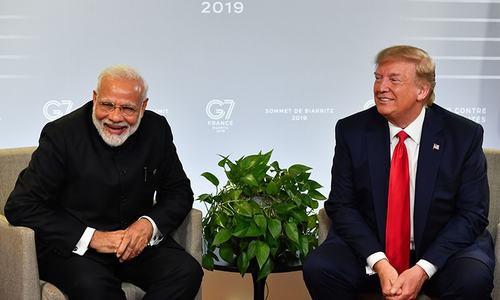
The announcement of an agreement was expected to coincide with Tuesday’s bilateral between Prime Minister Narendra Modi and President Donald Trump. “We will have a trade deal soon. We will have a bigger trade deal down the road,” Trump said before the talks held on the sidelines of the UN General Assembly meeting.
While Foreign Secretary Vijay Gokhale did not share details on why a trade package could not be concluded, three sources familiar with the negotiations told The Hindu that the prospects of an agreement unravelled as the US wants India to eliminate tariffs (20 per cent) on ICT products, but New Delhi is concerned that this could open up the market to flooding by Chinese technology. The US wanted greater access to Indian markets for medical devices, such as stents and knee implants, ICT and dairy products and sought the removal of price caps.
The US had sought the removal of price caps (Trade Margin Rationalisation) on medical devices and greater access for dairy products and some other categories of agricultural goods.
On its part, India wanted the reinstatement of preferential market access to US markets under the Generalised System of Preferences (GSP) programme, which was revoked in early June. It had also wanted facilitation of processes in agricultural product markets where it already had access (such as easier certification of food product irradiation facilities) and greater access in some agricultural markets (table grapes, pomegranates for instance), sources told The Hindu.
Published in Dawn, September 26th, 2019