French authority rejects pre-emptive 'yellow vest' protest bans


 1
1

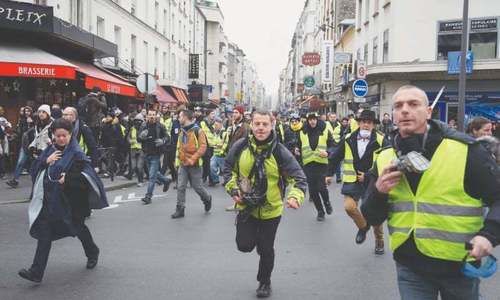
France's Constitutional Council on Thursday struck down a measure that would have let authorities ban certain individuals from protesting, a key element of the government's plan to crack down on violence at “yellow vest” demonstrations.
The council, which rules on the validity of laws, said the proposal gave officials “excessive latitude” to justify the individual bans against people suspected of being "a particularly serious threat to law and order".
The move was inspired by anti-hooligan measures that keep out known troublemakers from football stadiums, but critics said it arbitrarily infringed on a person's right to freedom of speech and assembly.
But the council upheld other measures of the law passed on March 12, such as more severe penalties for organisers of unauthorised demonstrations, and for people who cover their faces during violent protests.
Demonstrators who defy protest bans will now face up to six months in prison and fines of up to 7,500 euros, while those masking their faces could be fined up to 15,000 euros.
France has been rocked by months of weekly Saturday protests by the yellow vests, which emerged over fuel taxes before snowballing into a broad revolt against President Emmanuel Macron.
The protests have often degenerated into rioting and fierce clashes with police in Paris and other cities, often by far-left and far-right extremists wielding metal bars or slingshots.
After subsiding as the protests waned early this year, violence flared again on March 16 when thousands of black-clad agitators battled police for hours while torching dozens of businesses.
The government has vowed to crack down on the destruction, outlawing recent protests on the Champs-Elysees in Paris as well as in other city centres.
The new law also gives police the right to search individuals and vehicles at or near demonstrations, to prevent people from bringing in objects that could be used as weapons.