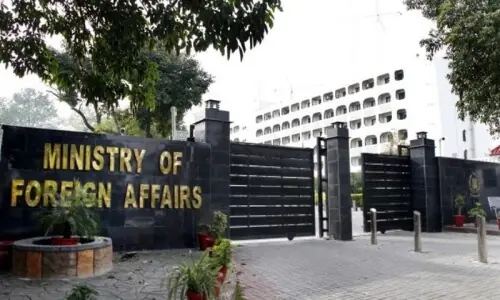
IT is unclear if he is unfit for the job, uninterested in it or has switched into campaign mode in a constituency near the Working Boundary. What is clear, however, is that Foreign Minister Khawaja Asif is roiling diplomatic waters with his decidedly undiplomatic remarks.
Moreover, parts of the sprawling cabinet of Prime Minister Shahid Khaqan Abbasi appear to be at war with each other.
While Foreign Minister Asif’s freewheeling Twitter statements have caused some consternation, his public attack, in an interview, against his cabinet colleague National Security Adviser (retired) Gen Nasser Janjua, for meeting the Indian high commissioner to Pakistan, Ajay Bisaria, in Islamabad is astonishing.
What purpose did Mr Asif hope to achieve with his remarks for the government he represents? Was Mr Asif simply freelancing, have constituency politics in Sialkot taken centre stage for him, or was there a method to the madness that has not been apparent to others since?
It is inconceivable that Mr Janjua could have met the Indian high commissioner without the permission of the prime minister. So was the foreign minister indirectly challenging and questioning the decisions of the prime minister?
Perhaps Mr Asif considers himself answerable only to his political boss, Nawaz Sharif, but it is not clear what purpose the attack on the national security adviser served in that case either.
Certainly, the appalling security situation in India-held Kashmir and the recent deaths of and injuries to scores of people in that region are of fundamental concern. Relations between India and Pakistan cannot be expected to improve while the people of IHK are suffering terrible repression by out-of-control Indian security forces in the region.
The purpose of the state-led violence is to bludgeon the brave people of IHK into submission so as to try and predetermine the outcome of any dialogue with Pakistan on the Kashmir dispute.
No country locked in a territorial dispute with a neighbour can be expected to eagerly embrace the latter in such circumstances. Neither should it fall only to Pakistan to try and stabilise a bilateral relationship with India that is lurching from crisis to crisis.
What has been apparent in the decades of a fraught Pakistan-India relationship, however, is that shutting down all channels of communication can open the door to even worse outcomes in which hawks on both sides dominate. The national security advisers of both countries should be allowed to continue their work as they deem necessary.
Published in Dawn, April 8th, 2018