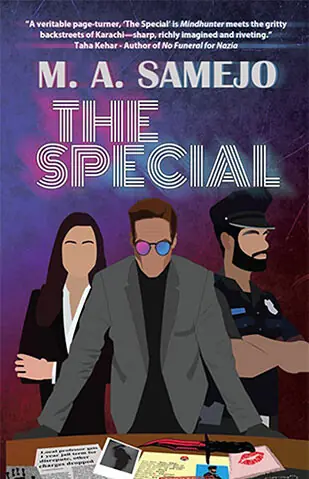
The Special
By Muhammad Ali Samejo
Liberty Publishing
ISBN: 9786277626631
500pp.
Pakistani fiction often treats difficult social subjects with caution. M.A. Samejo’s The Special takes a different route.
The novel places taboo topics at the centre of its narrative and uses crime fiction as a framework for exploring them. Its most notable achievement lies in its willingness to confront subjects that are frequently discussed in private yet rarely examined at length in popular fiction.
At first glance, The Special appears to belong firmly within the detective genre. There are investigations, mysteries and a protagonist tasked with uncovering hidden truths. Yet the book’s deeper interest lies elsewhere. The crimes function as entry points into broader discussions about social behaviour, cultural expectations and the private burdens people carry beneath carefully managed public identities.
The novel centres on Dr Zurain Shah, a psychologist whose methods and temperament place him outside the familiar mould of the conventional detective. The novel opens with Dr Zurain Shah in police custody, accused of assaulting students of Merchant University and pursued through Karachi by Inspector Akbar Khan during a torrential storm. What follows is a series of investigations undertaken alongside Inspector Akbar Khan and a recurring cast of police officers, pathologists and victims whose lives intersect with crimes involving abuse, obsession, exploitation and violence.
Through a series of interconnected investigations, a detective genre novel uses crime fiction to explore taboo social issues in contemporary Pakistan
The cases initially appear self-contained, each centred on a different mystery, before gradually revealing connections that culminate in a larger reckoning for Zurain himself. The structure allows Samejo to move between police procedural, psychological thriller and social commentary, without losing sight of the central mystery surrounding his protagonist.
Zurain possesses intelligence, confidence and a tendency to provoke. He frequently challenges the assumptions of those around him and, by extension, the assumptions of the reader. Samejo’s decision to build the novel around such a figure proves effective. Zurain remains compelling because he resists easy categorisation. He is neither an uncomplicated hero nor a symbolic mouthpiece. He occupies a space between those extremes, allowing the narrative to remain morally complex.
The book’s structure reflects its origins as a series of interconnected stories. Individual cases unfold with relative independence before contributing to a larger narrative framework. This seems like Samejo’s strength, as he did something similar in his previous book, Legends of Karachi. This design serves the novel’s thematic ambitions well. Each investigation opens a different window on to Pakistani society, exposing tensions related to family, sexuality, power, faith and social reputation.
The novel’s most interesting contribution lies in its treatment of taboo. Contemporary Pakistani literature has produced a growing number of works concerned with social silence and cultural repression. Samejo joins that conversation through the genre of fiction rather than literary realism. The choice matters. Crime fiction attracts readers who may not otherwise seek out novels focused on social critique. By embedding difficult subjects within an accessible narrative, Samejo broadens the reach of those discussions.
Such an approach carries risks, however. Episodic fiction can struggle to maintain momentum or coherence. The Special avoids that problem for much of its length because Samejo understands the mechanics of suspense. He knows when to reveal information and when to withhold it. The narrative moves at a steady pace, keeping readers engaged even during passages that prioritise discussion over action.
The novel’s most interesting contribution lies in its treatment of taboo. Contemporary Pakistani literature has produced a growing number of works concerned with social silence and cultural repression. Samejo joins that conversation through the genre of fiction rather than literary realism. The choice matters. Crime fiction attracts readers who may not otherwise seek out novels focused on social critique. By embedding difficult subjects within an accessible narrative, Samejo broadens the reach of those discussions.
Karachi occupies an important place in this project. The city functions as more than a setting. It shapes the behaviour of the characters and influences the atmosphere of the novel. Samejo presents Karachi as a place where wealth and deprivation, conservatism and modernity, visibility and secrecy exist side by side.
The city mirrors the contradictions that define many of the characters themselves. The opening pursuit through a flooded Karachi, for example, establishes institutional dysfunction, class tensions and social frustration through action rather than exposition.
The prose favours clarity over ornamentation. Samejo writes with confidence, avoiding excessive description in favour of dialogue and movement. This approach works. Readers encounter the story primarily through action, conversation and investigation rather than lengthy reflection. The result is a novel that remains well-paced without sacrificing themes.
Dialogue emerges as one of the author’s strongest tools. Conversations frequently carry the burden of characterisation and social commentary. Zurain’s exchanges, in particular, provide some of the book’s sharpest moments. Samejo demonstrates a strong ear for conversational rhythm and understands how disagreement can reveal character more effectively than description.
One of the most interesting aspects of the novel appears in the epilogue and should be discussed. The epilogue reframes much of what precedes it. A decade after the main events, Zurain is serving time in prison when he is approached by Inspector Fariha, his daughter. Their conversation reveals fragments of his earlier work as a police consultant and introduces a disturbing new murder case involving a food influencer whose body is arranged as part of a shocking public display in a crowded restaurant.
Yet, the novel’s strengths occasionally also create corresponding weaknesses. Its commitment to addressing major social issues sometimes leads to moments where intent becomes too visible. Certain scenes appear designed primarily to communicate an idea rather than advance character or plot. Readers may occasionally feel the author directing attention toward a social argument that would have carried greater force through implication.
The supporting cast presents a similar challenge. For instance, Inspector Akbar Khan emerges as more than a procedural foil to Zurain. Their exchanges provide some of the novel’s sharpest moments, particularly during the opening arrest sequence, where Akbar’s certainty collides with Zurain’s mocking confidence. As opposed to this, several figures introduced through individual cases receive less sustained development. Victims, suspects and witnesses often enter the narrative carrying the weight of a particular social issue, then recede once the investigation concludes.
An example is Marvi Khoso, who is a wealthy socialite and social media personality and whose death becomes the focus of an investigation. The same is the case with Basharat Azam, a wealthy and influential figure, and Dildar Bughio, a powerful politician, along with his wife, Sahar Bughio, both of whom become connected to a case. Their function within the plot is clear, though their personal histories remain underexplored. Some depth in supporting roles would have strengthened the novel’s impact.
These reservations should be understood in proportion to the book’s broader accomplishments. Ambitious novels often risk unevenness because they attempt more than straightforward genre entertainment. The Special belongs to that category. Samejo is interested in suspense, but he is equally interested in the social conditions that produce secrecy, enable violence and personal conflict. The novel gains much of its energy from that dual focus.
Within the context of Pakistani writing, the novel occupies an interesting position. It sits between literary fiction and commercial fiction, borrowing techniques from both traditions. The book demonstrates that popular genre writing can engage seriously with social questions without becoming too preachy. That balance remains difficult to achieve. Samejo comes close more often than he falls short.
For readers interested in contemporary Pakistani fiction, the novel offers a useful example of how genre literature can participate in larger cultural conversations. Samejo may not resolve all the tensions he introduces, yet the attempt itself gives the book much of its significance. Its most persuasive achievement is that it presents crime fiction as a space for social inquiry.
The reviewer is a content lead at a communications agency
She can be reached at sara.amj@hotmail.co.uk
Published in Dawn, Books & Authors, July 19th, 2026