0
0

For two weeks, Shahrez Khan’s world shrank to the size of a prison cell.
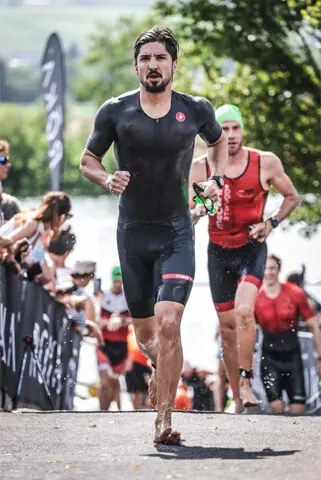
The elite triathlete who measures life in kilometres suddenly had nowhere to go. An athlete whose days begin before dawn — swimming laps, riding endless kilometres or pounding the roads on another run — was confined to four walls, stripped of the routine that had become second nature.
“I’ve always thought of myself as a positive person,” he tells me months later. “Being in a confined environment… other than having faith or mental resilience, what else do you have? I just kept believing things would get better.”
His arrest in August 2025 thrust him into the national spotlight for the first time.
Until then, Shahrez had lived largely outside the public eye. Despite belonging to one of Pakistan’s most recognisable political families — he is the son of Imran Khan’s sister Aleema Khan — he had deliberately kept a low profile, focusing instead on his textile export business, his family and a sporting obsession that few outside endurance circles knew much about.
Shahrez Khan is among the brightest stars on Pakistan’s triathlon landscape. He qualified for the prestigious Ironman 70.3 World Championship as well as for Pakistan’s Asian Games squad. However, the real test of his endurance may be off the field…
He was arrested in connection with cases linked to the May 9, 2023 riots. His family maintains that he was targeted because of his relationship to the former prime minister, while authorities say the cases are part of ongoing legal proceedings stemming from the unrest. Shahrez spent two weeks in custody before being released. The experience, he says, tested him mentally but never altered the way he viewed life.
And, at 44, Khan laughs at the idea that his best years are behind him.
“Age is just a number,” he says. “You’d be amazed what our mind and body is capable of. The mind plays a big role. As long as you’re willing to push yourself, you’ll be amazed what your body can deliver. I think I’m in my prime right now, and I want to make the most of it.”
That optimism would soon be tested again.
BUILT FOR DISTANCE
Long before he became known for politics he had nothing to do with, Shahrez Khan was quietly becoming one of Pakistan’s finest endurance athletes.
The irony is that he never set out to become one.
At school, he discovered something about himself. He wasn’t the fastest sprinter, but he was one of the better long distance runners. Cross-country became his first love. Swimming followed, eventually earning him selection for the Punjab team. Years later, while studying at Oxford, he continued running and making it to the Said Business School Cross Country Team — not to compete, but because he found running liberating and loved pushing himself.
“I realised I enjoyed challenging myself more than competing,” he laughs. “There is a famous saying in Ironman: ‘Suffering is a privilege.’ Endurance sports are all about mental resilience. There is suffering. There is negativity that kicks in sometimes. You really have to push through it.”
That quiet competitiveness stayed with him through his twenties and into his thirties, when in 2019 a friend persuaded him to sign up for a half-marathon in Islamabad and he was hooked.
Then came an even bigger challenge.
THREE MONTHS TO BECOME AN IRONMAN
Among triathletes, the Ironman 70.3 World Championship is the pinnacle of middle-distance triathlons. Athletes qualify by earning coveted slots at Ironman 70.3 races around the world, making it an invitation-only event for the sport’s top age-group and professional competitors.
In 2022, his friends invited him to compete in an Ironman 70.3 in Luxembourg, Shahrez laughed. “I could run and I could swim,” he says. “But I’d never really ridden a bike.”
The race was just three months away. Most triathletes spend years preparing for their first event. Shahrez had 90 days. He managed to finish with a respectable time.
“I went there just to finish,” he says of his first Ironman 70.3 in Luxembourg. “It was an overwhelming experience. I felt extremely grateful to have finished it in a decent time. That started an obsession and a passion.”
It wasn’t simply about crossing the finish line. It was about discovering the satisfaction of becoming a little stronger every day. These races became a way of life.
“Something that started as a challenge became a passion,” adds Shahrez. “I wanted to be the best in Pakistan and raise my level and be as good as the elite age-group athletes in the world. I have finished twice in the top 10 in my age group, in the Ironman 70.3 races held in South Africa [November 2024] and Philippines [March 2025].”
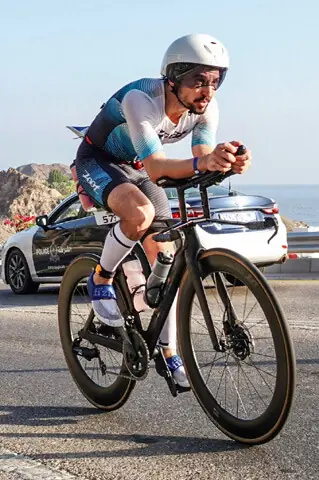
Luxembourg led to New Zealand, Turkey, South Africa, Oman and the Philippines. Training became a daily ritual.
He wakes up at 5.30am every day so he can finish before his family is up and in time to start his work day. “Smog in Lahore, heat in Karachi or freezing winter mornings simply became part of the process,” relates Shahrez. “Because of the smog in Lahore, I can’t train outside for six months out of a year. I have to train indoors, which is harder but ultimately builds more resilience.
“There are days when you don’t want to get out of bed,” Shahrez shares. “There are days when there is smog outside or it’s too hot. That’s mental resilience you have to build over time. The progress is slow. You have to keep at it, train smarter, and be patient. It’s taken me years of training and a lifestyle to build a strong athletic base, which has helped me catch up with athletes who’ve been doing this much longer.”
THE HOLY GRAIL
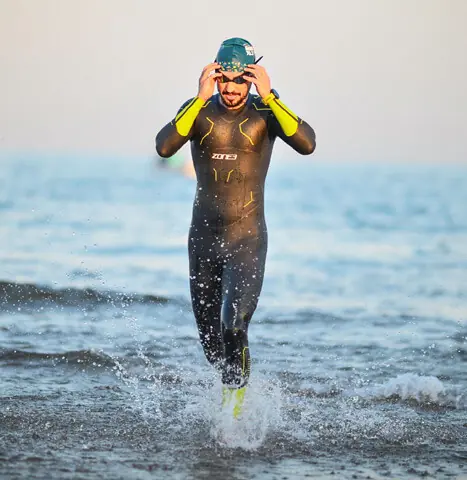
The Ironman 70.3 refers to the total race distance in miles — comprising a 1.9-kilometre swim, a 90-kilometre bike ride and a 21.1-kilometre half-marathon. Only a tiny fraction of athletes earn a coveted qualifying slot through races around the world.
Shahrez earned his in the Philippines after finishing seventh in his age group, becoming only the second Pakistani ever to qualify for the Ironman 70.3 World Championship that was held in November last year.
“It was the holy grail,” he chuckles. But he never got to race in the World Championship.
Shortly before the event, he was preparing to travel to Estonia sometime in August 2025 for another Ironman 70.3 event. It was then that he discovered he had been placed on Pakistan’s exit control list, preventing him from leaving the country.
He says no explanation has ever been given. “It affected my work as well,” he says. “I contribute to Pakistan’s textile exports and bring business into the country. I’m not political. I’m a professional.”
But frustratingly, instead of lining up with the world’s best triathletes in Spain, he could only watch from home.
STILL RUNNING
For many athletes, missing the biggest race of their careers might have broken their spirit. Instead, Shahrez simply found another finish line.
Trials for Pakistan’s triathlon team opened ahead of the Asian Games, due to be held in September 2027. He entered and, unsurprisingly, came out as the top qualifier.
Representing Pakistan, he says, would mean even more than competing as an individual Ironman athlete. “I would love to wear the green blazer,” he says. Yet the same travel restrictions continue to cast doubt over whether he will be allowed to compete. If he cannot travel, he says, he will willingly give up his place so another athlete can represent Pakistan.
It is perhaps the only time during our conversation when frustration briefly creeps into his voice. “These are my prime years,” he says. “I’ve always been a positive person. I will not stop training. I will not give up. If I miss the World Championship this year, I’ll qualify next year. If I miss the Asian Games this year, then I’ll focus solely on qualifying for the full Ironman Championship in Kona, Hawaii, InshAllah.”
Endurance athletes understand something few others do: the hardest races are not always the ones measured in kilometres. Sometimes, they are measured in patience.
The writer is a journalist, an award-winning documentary filmmaker and radio correspondent. Instagram: @madeeha.syed
Published in Dawn, EOS, July 19th, 2026