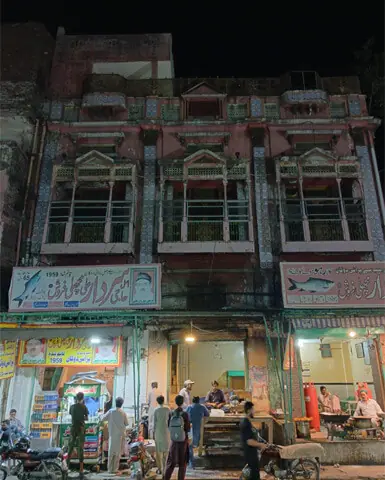
On a warm morning this past May, I returned to Gawalmandi, eager to see what remained of one of Lahore’s most celebrated neighbourhoods.
Guided by a friend who knows every twisting lane of the area, I approached the neighbourhood from Nisbat Road through Mayo Hospital. Just opposite the hospital, a narrow passage beside a row of thrift shops opens into Gawalmandi, almost hidden from the traffic outside.
Celebrated until recently as the hub of Pakistani cuisine, Gawalmandi now tells a tale of neglect and fading heritage.
Once the beating culinary heart of Lahore, Gawalmandi now stands as a shadow of its former self…
THE STREET THAT NEVER SLEPT
Located just outside the Walled City, it derives its name from the cattle herders who once inhabited the area. Although it developed into a residential neighbourhood over the decades, it became nationally renowned for its food street.
The area would come alive at night, with tables and chairs occupying most of the main passageways. Motorcyclists invariably struggled to navigate the crowded food street and, more often than not, endured expletives from unsparing Lahori aunties whose feet came under their wheels.
My earliest memory of Gawalmandi dates back to 2009, when I visited as a 10-year-old with my extended family. I saw foreign tourists, particularly women, in attire that would otherwise not be a common sight in the city.
I noticed that most of the elderly women accompanying us kept looking at these foreign women, clicking their tongues and repeating the word beysharam [shameless] over and over again.
One of them told her husband, “Mian Sahib, I wonder if there is no one to keep a check on them!” Mian Sahib, meanwhile, seemed to be taking a rather thorough look himself, and replied: “Everything seems perfectly fine to me.” Enraged, she turned to the other aunties nearby who shared her disapproval, muttering under her breath about the tourists.
A FEAST IN DECLINE
But much has changed in the following 17 years.
During my recent visit, I could scarcely believe this was the same place where diplomats, tourists, the local crème de la crème, and people from almost every section of society once gathered for their meals.
I can vouch for the variety of cuisines that were once available on this single street. Having a particular fondness for tandoori chicken and barbecue, I can recall dozens of barbecue dishes that could be ordered. The smoke would constantly rise from the angeethis [braziers] as ustaads [experts] deftly turned meat-laden skewers over the flames, eyes half-shut against the haze.
Bearers, who knew every dish on the menu by heart, would rush towards newcomers and recite the names of delicacies at a bewildering pace.
All that spectacle was now gone. An all-pervasive gloom hung over the street. Restaurant owners sat gazing expectantly at passersby, hoping someone might stop.
VOICES OF THE OLD STREET
Reaching the end of the food street, I turned into an adjoining lane. There, I saw Jameel Butt sitting on a bench outside a shuttered shop. He was immaculately dressed — a starched white kurta paired with a light-coloured dhoti . His pencil moustache and cropped hair gave him the appearance of a pehelwan [wrestler] from a bygone era.
Butt told me that he was born and raised in Gawalmandi, and loved everything about the locality. At one point, he had built a house outside Gawalmandi, near Lal Pul [literally, Red Bridge], close to Mughalpura, as it was near his place of business. He would live there for eight years but, by his own admission, never felt at home. Eventually, he shifted back to Gawalmandi. “All my best memories are associated with this place,” he said.
Like many longtime residents, Butt has a few stories about Nawaz Sharif, the three-time prime minister and a regular visitor to Gawalmandi. “He would often come to eat hareesa [mutton stew] and paaye [mutton or beef trotters] at the homes of Kashmiri Butts [a well-known local clan],” he said.
When I asked him where those houses were located, he merely pointed towards the endless street. He appeared to be a staunch supporter of Sharif’s political party, the Pakistan Muslim League-Nawaz (PML-N), and spoke highly of the initiatives undertaken by the current Punjab government. I thanked him and retraced my steps towards the main stretch of the food street.
There, I met Usman Billah, another resident of Gawalmandi and the owner of a small eatery. He told me that the raunaq [liveliness] never truly returned after 2012, when the Gawalmandi food street was shifted to Fort Road. Back then, reminisced Billah, Gawalmandi “belonged to warm-hearted people.”
“But those times are long gone, when babas [old men] clad in dhotis, would sit together late into the night smoking the hookah,” he said. “The days were lively, but the nights were even livelier.”
Saifullah, who has a fast-food stall next to Billah’s eatery, listened in on our conversation as he waited for his first customers of the day. I also asked him why and when Gawalmandi began to decline.
While Butt praised successive PML-N governments, Saifullah blamed them for Gawalmandi’s decline. Saifullah offered a slightly different timeline, saying that, after the initial closure and the inauguration of the new food street on Fort Road, the original Gawalmandi was allowed to revive the food street following protests.
“Although it reopened a few years after being shut down, the hustle and bustle never returned and Covid-19 proved to be the final nail in the coffin,” Saifullah said.
WHY IT REALLY MOVED
Both Saifullah and Billah told me that the government had shifted the food street on the pretext that residents of this dense, historic neighbourhood were facing difficulties in commuting.
The main passageway where the food street was located is the only exit for those living in houses in the adjoining lanes. At night, it would become impossible for a vehicle to navigate through the narrow passageway.
I could see that the government’s concern was legitimate, but it gave little consideration to the lives and livelihoods of those who had relied on the food street. Saifullah and Billah insisted that the government had the wherewithal to provide them with an alternative instead of shutting them down. It appeared to me that the two men hoped the current government would act to restore Gawalmandi’s old spirit.
As I prepared to leave, I watched people pass the entrance of a restaurant without sparing a glance at its intricate and beautiful jharokas [ornate overhanging balconies].
Gawalmandi has survived empires, Partition and political upheaval. What it now risks losing is something less tangible: the everyday life that once made it one of Lahore’s most vibrant neighbourhoods.
The writer is a storyteller with an MPhil in English. He can be contacted at usama.malick183@gmail.com
Published in Dawn, EOS, July 19th, 2026