
One fine afternoon, I was enjoying a leisurely walk after the rain near a forest. I stopped under a huge tree to dislodge a stone from my shoe when I suddenly heard a voice.
“Hello there!”
I looked around.
“Down here,” said the voice.
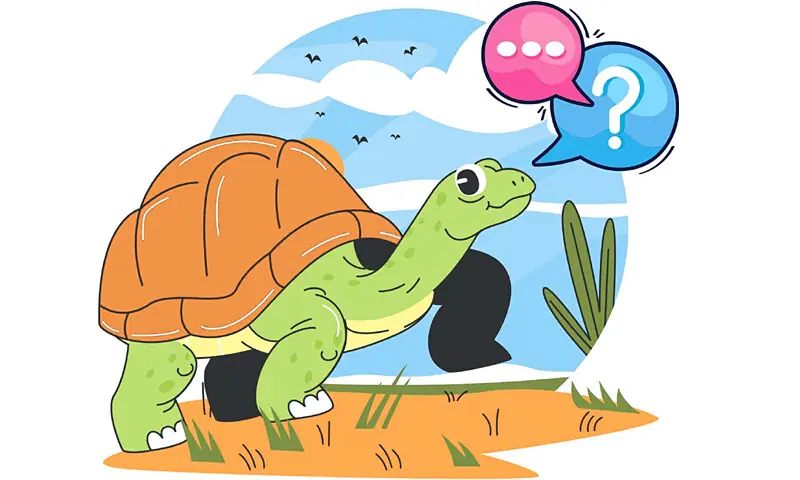
I looked down at the muddy trail littered with fallen leaves and saw a... tortoise! Its round head peeked out of a hard, dome-shaped shell as its leathery neck craned up to look at me.
“Err... what are you doing here all by yourself?” I asked.
“I am waiting for the hare. We were competing in a race,” it said.
I had, of course, read the famous fable, “The Hare and the Tortoise,” but the tortoise’s answer still astounded me.
“So, where’s he?” I asked, looking around curiously.
“Sleeping under a tree, I presume. I’ve been waiting here a very long time,” it replied in its deep, patient voice.
What! Some things never change after all, it seems.
“Oh well, while you wait, can you tell me about yourself?” I asked.
“Of course! The world can learn a lot from us. We have been around for over 220 million years, longer than many dinosaurs,” he said in a manner that reminded me strongly of Master Oogway from the Kung Fu Panda movie.
I dug out my trusted notebook from my backpack and sat down on a log so the poor creature wouldn’t have to crane its neck up at me all the time.
“There are over 50 species of tortoise in the world. The smallest is about four inches long, but there are also giant tortoises like the Galápagos tortoise that can weigh over 500 pounds! I am an Indian star tortoise, native to India, Pakistan and Sri Lanka... but not for long.”
“Why not?” I asked in surprise.
“Unfortunately, we are on the Red List of Threatened Species compiled by the IUCN (International Union for Conservation of Nature). This means our numbers are decreasing so fast that we could become extinct in the foreseeable future,” it answered, looking up at me with sad eyes.
“What are the biggest threats you are facing?” I asked.
“Habitat loss, climate change and urban development are causing a rapid decline in our population. In many Asian countries, tortoise meat and eggs are considered a delicacy. In some cultures, our shells are powdered and used in traditional medicines, so illegal poaching and hunting are also driving us towards extinction.”
“What is the difference between a turtle and a tortoise?” I asked, trying to change the subject.
“Turtles spend most of their lives in the water. They have webbed feet or flippers for swimming and flat, streamlined shells. We live on land and have sturdy, elephant-like legs for walking. Our shells are high and dome-shaped. Turtles are fast swimmers, but we live much longer.”
“And what is your diet?” I asked.
“We are herbivores and like to eat grass, flowers, fresh shoots, berries and fruits when available. We don’t have teeth, so we use our strong jaws and beak-like mouths to pull and tear vegetation.”
“And what do you do all day long? I mean, what is an average day like for a tortoise?” I tried to ask politely because it was difficult to imagine a tortoise doing anything other than plodding along all day.
“We might look slow-moving, but tortoises play a very important role in the ecosystem. A decline in our population can have cascading effects throughout the ecosystem. We are a prime example of a keystone species.”
“Err... what species?” I asked.
“Keystone species, my dear,” it replied patiently.
I had no idea what a keystone species meant. Swallowing my pride, I asked, “Can you tell me a bit more about keystone species?”
“Keystone species are animals or plants that are critical for the survival of other species. They can be huge predators, tiny insects, fungi, bacteria or even unassuming plants. Without them, ecosystems may collapse because they maintain biodiversity and keep habitats balanced.
“So how are tortoises keystone species?” I was still not convinced.
“Our cousins, the gopher tortoises, are prolific diggers. They dig burrows that provide shelter for at least 360 other animal species from forest fires and predators. Burrows also provide refuge during winter and the summer heat. Just imagine a forest fire... without burrows dug by gopher tortoises, many species of insects, snakes, frogs, rabbits and squirrels would die, followed by owls, foxes and eagles that prey on them.”
Oh, I swallowed hard. I do not want to imagine such a world, even for a second, where there’s no wildlife.
“Do you have any message for the readers of Young World?” I asked.
“Yes. Slow and steady wins the race,” it said.
“Ha ha!” I laughed politely, remembering the famous fable in which the tortoise wins the race while the hare sleeps under a tree.
“No, really. It is true that hard work and perseverance pay off. Let me share some wonderful news. Just recently, the Galápagos National Park Directorate and its conservation partners released 158 giant tortoises on Floreana Island in the Galápagos, near Ecuador.
“Floreana Island was once rich in wildlife. Around 97% of Galápagos reptiles and land mammals are found nowhere else on Earth. Sadly, about 200 years ago, pirates, merchants and whalers reached the island. They captured thousands of tortoises for food during long sea voyages. They also brought pigs, cats, goats and rats, which ate tortoise eggs and hatchlings.
“Eventually, our population disappeared and the island began to change. Many native plants and animals became rare, creating an ecological disaster. Even the soil and weather patterns changed. Conservation experts spent years clearing these predators before releasing us into the wild because they hope to restore the island’s natural balance.
“Think of us as ecosystem engineers. We trample thick bushes and create pathways for other species. We also spread seeds in our droppings, helping new plants grow, and our burrows keep many other species safe.
“When our population thrives, other rare species thrive too, and with consistent effort and perseverance, balance will be restored.
“The past cannot be changed, but where there’s a will, there’s always a way. Hopefully, together we can build a future where humans coexist peacefully with other species of the world!”
The sun began to set. I watched my guest slowly turn and head back into the woods. I remained seated on my log, thinking about the wise words...
Fun Facts
When multiple tortoises are together, they are called a “creep”.
Tortoises can hold their breath for a long time by tucking into their shells to avoid predators.
They can survive for months without food or water.
Tortoises use their throats to smell, which is an interesting way to sense the world around them.
Most tortoise species have a lifespan of about 80–150 years, but some can live for over 200 years!
A tortoise called Jonathan is currently the longest-living land animal in the world, at around 190 years old. Can you think of all the world events it has witnessed?
Published in Dawn, Young World, July 18th, 2026