Afghanistan’s lost peace
WHEN the Taliban entered Kabul in August 2021, the world feared Afghanistan was heading towards an unprecedented humanitarian catastrophe. Those fears proved well-founded. Yet few imagined that nearly five years later, Afghanistan would remain one of the world’s gravest humanitarian crises despite the absence of a nationwide civil war.
The United Nations warned in 2022 that almost half the Afghan population was facing acute food insecurity. With the advent of the Taliban, the banking system had collapsed, millions had lost their livelihoods, and the sudden suspension of international assistance had pushed the economy into free fall. More importantly, professionals already in short supply started leaving the country. At the same time, women were progressively excluded from public life, girls were denied secondary education, and poverty became the defining feature of Afghan society. Those early warnings have not simply materialised; they have grown with each passing year.
Today, Afghanistan presents one of the greatest paradoxes in contemporary international politics. The Taliban have succeeded in ending a four-decade-long insurgency and now exercise authority over almost the entire country. Armed conflict has declined significantly compared with the final years of the previous republic. Yet military victory has failed to produce either economic recovery or national prosperity.
According to the World Bank’s latest assessment, Afghanistan’s economy may be resilient even as living standards deteriorate. Domestic revenues have increased, inflation has eased, and modest economic growth has returned after the unprecedented contraction that followed the Taliban takeover. Yet these encouraging indicators conceal a sobering reality. Population growth continues to outpace economic expansion, foreign assistance is steadily declining, unemployment remains widespread and at an all-time high, while private investment is virtually absent. The result is what may best be described as stability without prosperity.
The Taliban’s military victory has failed to produce national prosperity.
The humanitarian picture remains even more alarming. According to the UN, almost 22 million Afghans — nearly one in two citizens — will require humanitarian assistance in 2026. Millions continue to experience acute food insecurity, while child malnutrition remains among the highest in the world. Afghanistan still hosts one of the largest humanitarian operations anywhere, a stark reminder that peace on its own does not feed people, create jobs or restore dignity. The tragedy is that humanitarian assistance has become a substitute for development rather than a bridge towards it.
International agencies deserve enormous credit for preventing widespread famine. Their food assistance, emergency healthcare, cash transfers and livelihood programmes have saved many lives. Relief keeps people alive. However, it does not create sustainable employment, rebuild financial institutions, attract investment or renew public confidence. Afghanistan has been locked into a cycle in which humanitarian assistance, while preventing collapse, cannot produce recovery.
Part of the responsibility undoubtedly lies with the international community. The abrupt withdrawal of development assistance, sanctions on the Taliban authorities, frozen Afghan financial assets and the country’s exclusion from the international banking system collectively produced one of the sharpest economic contractions witnessed in any post-conflict society. Although these measures were intended to deny legitimacy to the Taliban, their principal victims have been ordinary Afghan citizens. Yet sanctions alone cannot explain Afghanistan’s continuing decline.
The Taliban’s own governance choices have significantly compounded the crisis. Their continued restrictions on girls’ education and women’s employment have deprived the country of half its human capital. No nation can expect sustainable development after systematically excluding half of its educated workforce from economic life. Beyond violating fundamental rights, these policies have reduced household incomes, weakened medical services, undermined education and discouraged both domestic and foreign investment.
Equally significant is Afghanistan’s continued international isolation arising from unresolved security concerns. The persistence of terrorist organisations — including the TTP, IS-K, ETIM, IMU, BLA and several others — remains one of the principal obstacles to wider diplomatic interaction and international recognition. Neighbouring countries continue to question whether Afghanistan is fulfilling its pledge that its territory will not be used to threaten others. Until this issue is addressed credibly, meaningful international normalisation will remain elusive.
Ironically, Afghanistan possesses enormous economic potential. Its vast deposits of copper, lithium, rare earth minerals, iron ore and hydrocarbons can attract international interest. However, natural resources alone cannot transform an economy. Investors require legal certainty, functioning banks, transport infrastructure, skilled labour and internationally recognised contractual frameworks. Political isolation and institutional weakness continue to damage these essential prerequisites.
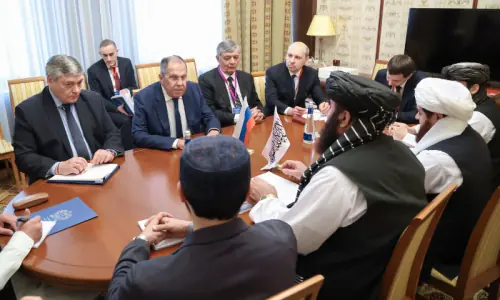
The international community needs to engage the Taliban regime on a conditional basis. Humanitarian assistance must continue without interruption, but development cooperation and economic integration should gradually expand in tandem with measurable progress on girls’ education, women’s participation in the workforce, political inclusion and credible counterterrorism commitments. Recognition must neither be automatic nor indefinitely withheld; it should reflect concrete improvements in governance and Afghanistan’s compliance with its international obligations.
Regional countries have a vital role to play. Pakistan, China, Iran, the Central Asian republics and the Gulf states have a strategic interest in preventing Afghanistan from becoming a permanently impoverished, unstable state. Greater regional trade, improved transit connectivity, investment in energy and transport corridors, and responsible development of its mineral wealth could gradually reduce dependence on humanitarian assistance. Pakistan, in particular, can continue promoting trade and humanitarian access while rightly insisting that terrorist sanctuaries on Afghan soil be dismantled as an indispensable condition for durable bilateral cooperation.
Taliban rule in Afghanistan is synonymous with poverty. It is the absence of a political and economic settlement capable of transforming military victory into national renewal. Unless the Taliban and the rest of the world move beyond managing crises towards rebuilding institutions and livelihoods, Afghanistan risks remaining trapped in a condition of stability without prosperity, and peace without progress.
The writer is Pakistan’s former special representative for Afghanistan. He is also a former ambassador to Iran and the UAE.
Published in Dawn, July 18th, 2026