0
0

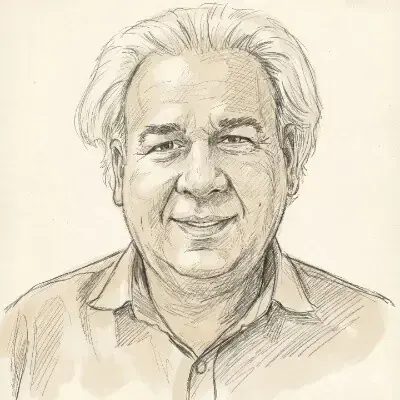
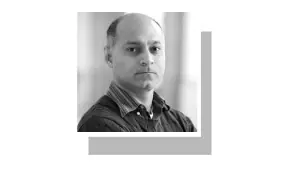
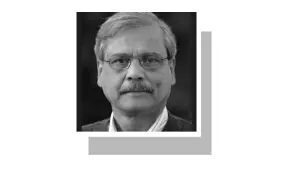
KARACHI: A big number of friends, colleagues and admirers of eminent journalist Mazhar Abbas came to the Karachi Press Club (KPC) on Saturday evening to listen to him narrate his journey as a media person at an event Jo Hum Pe Guzri organised by the club’s literary committee.
Going back in time, Mr Abbas, whose childhood was spent in Hyderabad, Sindh, said he was in class VIII or XI when he read about Pakistan losing the 1971 war. It was for the first time that he realised how news got published in papers, because before that, the newspapers had written that we’re winning the war.
Recalling his time spent in Hussain D’Silva Town in North Nazimabad, where his family lived, he said: “Hussain D’Silva Town was a big example of how people lived happily. Christian and Muslims lived together and participated in each other’s festivities. Now that I look back, I see that when I joined journalism, Karachi had changed a lot. Prior to that, there used to be Palace Cinema, Rex Cinema… How did the city change? This was preparing a journalist within me.”
Mr Abbas said: “When I reached university, things had gotten bad. Not just in the city and country, but even at universities. Still, in those days, we would campaign against our opponents in the daytime and in the evening have tea with them.”
He said as a journalist, he wrote his first piece for Nawa-i-Waqt from Karachi. After that, following someone’s advice, he said he met with Hameed Haroon, who asked him to join Star (evening newspaper) as a reporter. The salary that he drew was Rs400.
“Our news editor at Star was Nargis Khanum. From there I [formally] started journalism. My first assignment was a result of a question that Khanum put to me, ‘how do you commute to the office’. I told her that I came from Hussain D’Silva Town by two public transport buses. She said write about that experience. When I submitted my first story, Khanum threw it in the bin, asking me to improve it. I wrote it three times. Finally, she put the story on the front page,” he said.
Mr Abbas mentioned the Jam Saqi case as one of his earlier significant stories as a journalist. This was when he realised how important ‘contacts’ were in journalism. “This is why I dedicated my second book to two journalists, Idrees Bakhtiar and Iqbal Jafri. They were the ones from whom I learned reporting, how to make contacts and protect them, and ‘if in doubt, leave it out’.”
He said the first high-profile cases that he covered were the Sohrab Goth and Aligarh, Qasba Colony carnages in 1986… and Pan Am Hijacking.
During his address, he recounted quite a few incidents involving many renowned names from different walks of life, which the audience listened to with great interest. For example, he mentioned that his first meeting with Benazir Bhutto took place in May 1986. He was a junior reporter at the time. “There was a press conference at 70 Clifton. I raised my hand to ask a question. Benazir said what my question was. I asked whether the US was involved in Zulfikar Ali Bhutto’s execution. She answered the way she wanted, saying why blame the US only, it’s Gen Zia and the judges,” he said.
Mr Abbas said the difference between working for a newspaper and TV is that with newspaper people don’t recognise the face of the journalist. But with TV, they recognise him, which can be harmful, too.
Answering a question, Mr Abbas said he met with Muttahida Qaumi Movement founder Altaf Husain on a few occasions and pointed out that the MQM needed to revisit how it treated the media in the late 1980s.
Published in Dawn, July 6th, 2026