0
0

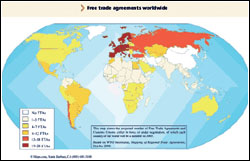 WITH a record external trade deficit of almost $11 billion and no respite in the higher oil prices, Pakistan is seeking free trade agreements with several countries and trade groups.
The government is too optimistic about signing such agreements with countries as varied as the US and China, Jordan and Bangladesh, but countries whether big or and small do not barter away their economic rights as readily as Pakistan is willing to do.
Also, it is one thing to sign such agreements and quite another to implement them fully and expeditiously.
Pakistan has signed an FTA with Sri Lanka, but that has not made any material difference in the volume of trade between the two countries.
The Pakistani rulers appear to be more keen on reaping the early harvest benefits of such deals rather than the overall gains flowing from treaty.
It has been observed that it is easier to sign general agreements with friendly countries than to implement them. For example, the many agreements between Pakistan and Iran for expanding trade and investment have not yielded any significant results.
Following the visit of the Jordanian planning minister to Pakistan, Prime Minister Shaukat Aziz said that the two countries had signed several agreements in various fields, but the volume of actual cooperation between them is small. Hence a new FTA agreement may not mean that the floodgates of trade would soon open.
We have already seen what happened in Seoul last week at the open hearing of the talks for an FTA agreement between the US and South Korea. The farmers there disrupted the public hearing and took to violence to project their rights.
It was easy for the US to sign the Northern American Free Trade Area Agreement with Canada and Mexico because of their close relationship, but the US could not for years or decades sign an FTA treaty with Mercosur group of large Latin American countries including Brazil, Argentina, Uruguay and Paraguay .
After protracted efforts, the seven countries of South Asia signed the SAPTA and then the SAFTA. But it is not making much headway in the volume of trade because the political difference between Pakistan and India. And other Saarc members are utterly frustrated. When it comes to economic interests, the countries fight inch by inch, particularly if political differences divide them.
Pakistan is now conducting FTA negotiation with the US, China and the Gulf Cooperation Council (GCC). It is also in such talks with Nepal, Bangladesh and other countries.
The negotiations between the GCC and India, however, are more advanced, according to the Indian commerce minister Kamal Nath and they are expected to sign FTA agreement this year.
Pakistan also wants to turn the Economic Cooperation Organisation of 10 Muslim states in central Asia and South Asia in to an FTA region.
The advisor to the Prime Minister Dr Salman Shah says the FTA agreement with the US will be signed next year. The FTA agreement with China too is expected to be signed soon. But the Chinese are not in a hurry while stepping up bilateral trade.
Meanwhile the prime minister wants Pakistan to enjoy the early harvest benefits of the agreement. Pakistan wants to become the hub of economic activity in the region, the energy corridor for China and trade corridor for the central Asian countries by providing access to the Arabian Sea and the Indian Ocean.
All that would call for tremendous improvement of roads, railways and airlines and the telecommunication system. Law and order too has to be improved vastly instead of 30 mobile phones snatched in Karachi alone every day. And the victim is shot, if he resists.
Balochistan has to be made truly peaceful and Gwadar elevated to the status of a well developed, modern port. The country has to have enough energy resources to meet the current needs and the future demands. Water too should be plentiful.
All these measures have to be taken in an environment of rising oil prices which has now shot up to $72 a barrel.
Iran has threatened to use the oil weapon if no settlement is reached on its nuclear energy dispute with the UN or the US. If Iran uses the oil weapon, it will be calamitous for the non- oil producing countries.
In Pakistan, the OGDC is developing only 50 oil wells next year, compared to last years target of 100 oil and gas wells which could not materialise.
This trade deficit has been kicked up by the high price of energy. Shortage of power is crippling the economy and increasing social unrest. Instead of the targeted $4 billion, trade deficit is at almost $11 billion or $10.636 billion.
The targeted export was at $17 billion which president Musharraf hoped would rise to $18 billion. But during the 11 months ending May, it has increased to $14.9 billion. And are exports expected to fall below $17 billion? But the imports shot up by 40 per cent to $25.598 billion in the last 11 months and may rise to $27 billion by the end of the month. All that makes preparing next years trade policy, very vexatious with the oil price moving above $72 a barrel.
Home remittances of overseas Pakistanis are at a record $5 billion for 11 months and have helped reduce the foreign exchange deficit. But now there has been a large fall in overseas employment, so the remittances will drop.
That makes the future rather hazardous. Pakistan will have to rely on privatisation earnings for foreign exchange. Even the foreign portfolio investment is not very large as it is only $347.8 million.
Pakistan is not the only country with such external trade problems due to soaring oil prices. In any case, the largest single item of import this year has been the machinery, which should help us make larger imports next year.
But the basic problem is that while we seek to sign FTA agreements with many countries, we do not have much of an exportable surplus. Positive steps have to be taken in that direction, to increase the exportable surplus and keep the exports cheap and marked for their quality.