Single bench order allowing Sheikh Rashid to travel abroad set aside

RAWALPINDI: The Lahore High Court (LHC) Rawalpindi Bench on Wednesday set aside a single-bench order that had allowed former federal minister and chief of Awami Muslim League (AML) Sheikh Rashid Ahmed to travel abroad for Umrah, ruling that suspects facing trial under the Anti-Terrorism Act (ATA) must seek travel permission exclusively from the trial court.
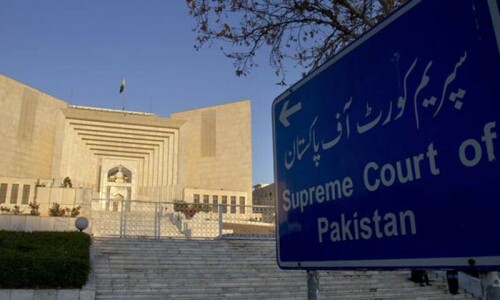
A division bench, comprising Justice Jawad Hassan and Justice Tariq Mahmood Bajwa, accepted the Intra-Court Appeal (ICA) filed by the Federation of Pakistan. The bench set aside the earlier decision to remove Mr. Ahmed’s name from the no-fly list, emphasizing that the High Court cannot substitute itself for a trial court in procedural matters specifically governed by special laws.
The 23-page judgment authored by Justice Jawad Hassan centered on the interpretation of Section 28-A of the ATA, 1997.
The court noted that this provision occupies a significant place in the statutory framework designed to combat terrorism while balancing fundamental rights.
Under Section 28-A, the passport of an individual accused of an offense under the Act is “deemed to have been impounded” for a period deemed fit by the court. The bench observed that this impounding occurs “not by virtue of any executive fiat but by operation of law itself” the moment an accused is charge-sheeted.
The judgment clarified that the term “Court” in this context refers specifically to the Anti-Terrorism Court (ATC) where the trial is pending. Consequently, the authority to regulate the use of a passport, including granting temporary permission to travel abroad, rests exclusively within the domain of the trial court.
The federation’s appeal challenged a Single Judge’s order from October 31, 2025, which had granted Mr Ahmed permission to travel to Saudi Arabia. That order was based on a statement by an Additional Attorney General (AAG) who had expressed “no objection” to the travel.
However, the division bench ruled that such a concession was “irresponsible” and made without a full appreciation of the legal framework. Invoking the doctrine of judicial estoppel, the court held that while consistency is a salutary principle, there is “no estoppel against law”.
“No officer of the State, howsoever senior, may by his unilateral statement before a Court dispense with the operation of a subsisting judicial order,” the judgment read.
The bench noted that the AAG was neither authorised to waive the application of the ATC’s general order nor possessed the legal competence to do so.
Addressing the respondent’s argument regarding Article 15 of the Constitution (Freedom of Movement), the court remarked that while the Constitution zealously protects individual liberty, these rights are not absolute.
The bench explained that Article 15 explicitly makes the right to move freely “subject to reasonable restrictions imposed by law in the public interest”. In this case, Section 28-A of the ATA constitutes a “lawful and reasonable restriction” intended to ensure the presence of the accused during trial and prevent the evasion of justice.
The court also highlighted procedural irregularities in the original writ petition, noting it was filed with a “vague and unclear prayer” that failed to challenge any specific administrative order. The bench referenced the 26th Amendment to the Constitution, noting that under the revised Article 199, the High Court should not issue directives beyond matters explicitly raised in a petition.
Furthermore, the bench took serious notice of Mr. Ahmed’s conduct. While the appeal was pending, the respondent approached the ATC for the same relief but allegedly concealed the fact that the matter was sub-judice before the High Court. The ATC had already warned the respondent to be careful in the future regarding the “concealment of material facts”.
Published in Dawn, March 19th, 2026