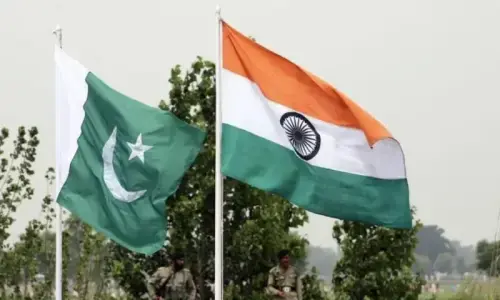
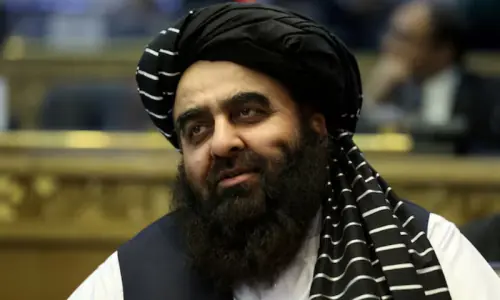
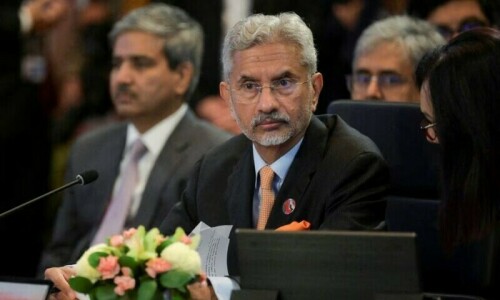
Defence Minister Khawaja Asif said on Tuesday that Pakistan was “ready” to confront aggression simultaneously on its eastern and western borders — a reference to India and Afghanistan.
Pakistan’s recent relations with both India and Afghanistan have been characterised by significant strain and tension. Pakistan fought a four-day war with India in May 2025 and had a border skirmish with the Afghan Taliban regime in October of the same year.
“Absolutely, we are ready, by the grace of God,“ said Asif on Geo News programme Capital Talk when asked if the country was prepared and capable of handling a war of aggression on its eastern and western borders.
Asif said the country and its armed forces had demonstrated proof of this preparedness during the May 2025 conflict with India.
“The way we gave them a crushing response is the strongest evidence that we were prepared and responded in time,” said the defence minister.
He maintained that the world witnessed how “Modi was thrashed” and how, following the conflict, he lost “all credibility both within his country and internationally”.
The minister further said that following the befitting response by the Pakistan armed forces, India “approached the US” for a ceasefire.
“You can determine from that how badly they were shattered — to the point that they had to call China.”
Pakistan‘s response, which came during the early morning hours of May 10, saw large-scale attacks with guided weapons and drones on Indian military targets. Airbases along the border, posts on the Line of Control (LoC) and India’s S-400 surface to missile systems were hit among other targets.
However, the defence minister expressed confidence that there would not be a full-scale war between the two nuclear powers when asked whether India could launch another attack, involve the Taliban, and then bring in US President Trump to enforce a ceasefire.
He further said that the four-day war with India enhanced Pakistan’s prestige. “Our armed forces’ strength is recognised by the entire world,“ said the defence minister, adding that recent orders for fighter aircraft show ”that our jets have been [battle] tested“.
The conflict between Pakistan and India was sparked by an attack on tourists in occupied Kashmir, which New Delhi, without evidence, linked with Pakistan. Islamabad strongly denied responsibility while calling for a neutral investigation.
But, New Delhi launched deadly air strikes in Punjab and Azad Kashmir on May 7, marking the beginning of the four-day clash. During the conflict, the Pakistan Air Force shot down at least six India fighter aircraft. After tit-for-tat strikes on each other’s airbases by the two sides, it took American intervention on May 10 for both sides to finally reach a ceasefire.