Clerics endorse family planning, but with a caveat
• Religious scholars support use of contraceptives, even abortions, in case of health risks; say issue needs to be delinked from food security, resources
• Legal expert says women have the right to decision-making related to childbearing
ISLAMABAD: In stark contrast to the traditional narrative prevalent among the religious segments, senior clerics on Tuesday endorsed the use of contraceptives and even abortions in case of health complications — but some opposed family planning if solely linked to resource constraints.
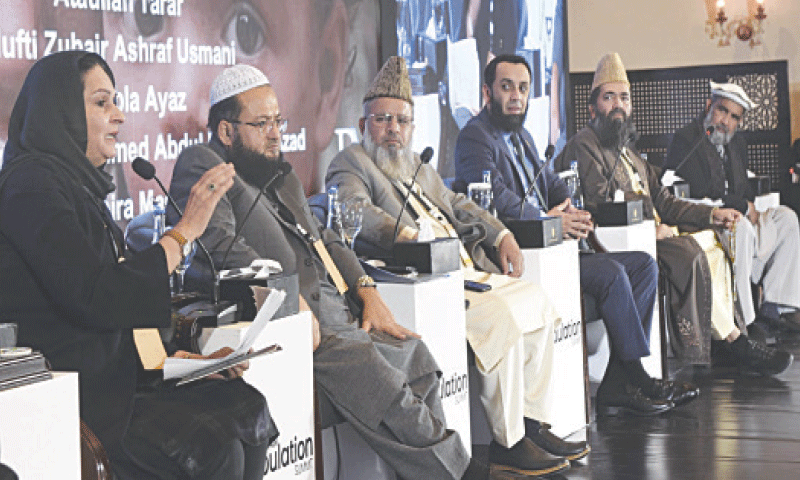
Speaking at ‘Population Balance as an Ideology’, largely attended by clerics and scholars, the religious scholars agreed that Islam allowed “birth spacing” and encouraged breastfeeding. The session, chaired by Information Minister Attaullah Tarar, acknowledged that the country was heading for a population explosion.
“We have to realise it,” the minister said, adding, “This is a male-dominated society and health issues of mothers are largely ignored.” According to the minister, the government too has to take the responsibility along with the religious segments and other members of society.
He asked the participants of the session and the organisers to devise a charter that should be discussed in parliament, as resource constraints, economic growth and women’s empowerment were directly linked to population growth.
The information minister said there were religious misconceptions regarding family planning, adding that there was a need to create awareness in this regard.
Speaking about the issue, Council of Islamic Ideology (CII) acting chairman Dr Raghib Naeemi underscored the importance of balance. For the collective good, a society needs educated, skilled and healthy members, he said. The scholar also highlighted the declaration of a seminar held by the CII in July 2025.
“We noted that a family needs a healthy mother and child,” he said, adding, “Birth spacing is good for the healthy development of mother and child, but adopting any non-shariah and unhealthy measure is not allowed.” He revealed that the CII seminar even acknowledged that abortions were allowed if there were life-threatening issues.
Dr Raghib Naeemi offered that the clerics were ready to correct the misconceptions of the past, but the government has to take the lead in this regard. “We need to learn from the collective wisdom and efforts of the governments and ulema of Iran and
Bangladesh.” Maulana Abdul Khabeer Azad, chairman of the Ruet-i-Hilal Committee, said that family planning was opposed by the clerics in the past, but the overall understanding of religious segments has now changed.
Maulana Azad stressed urban management for healthy population management, and suggested that leaders of other religious communities be engaged in promoting population management awareness.
Speaking about the opposition to the family planning initiatives by the clerics, Dr Qibla Ayaz, member of the Shariat Appellate Bench at the Supreme Court of Pakistan, highlighted that the clerics had never supported these programmes since their beginning in the 1960s. The speeches of top clerics in the country against family planning are on record, including those that were made in parliament.
He added that the successive governments failed to present a “correct narrative”, as linking high population growth with food insecurity was not right. He, however, agreed that the population boom was having an impact on mothers’ and children’s health as well as causing other social problems.
Similar views were expressed by Mufti Zubair Ashraf Usmani, vice president of the Jamia Darul Uloom Karachi. He claimed the population growth was not an issue and neither was it creating food security.
Mufti Usmani maintained that children were a blessing and that the Almighty would provide food to each soul. He, however, found family planning useful if health concerns were compelling. In a separate session, rights activist Tahira Abdullah, however, contested this argument. “When we give permission, it should be from a moral, ethical and rights-based background, not on a transactional basis. ‘If a woman’s health is not good, then she can employ birth spacing’. I’m sorry; that is not acceptable,” the activist said.
Advocate Humaira Masihuddin, scholar and legal expert, said that women’s participation in the issues that concerned them was limited, which was unfair. She referred to several verses of the Quran and Hadith that women’s rights were part of the shariah. The women has the right to decision-making related to childbearing, she said.
“Our women suffer from anaemia, malnutrition and other health issues – but they are not given any choice when it comes to having more children,” Ms Masihuddin added.
She said, “In every pregnancy, the risk and threat of death is very real. Not asking the person who has to take such a huge risk or their consent not being included is inconceivable.”
“I cannot believe that the shariah would ever allow something like this,” she added, prompting a huge applause from the audience.
She also referred to a lecture of the grand mufti of Al-Azhar, who stated that there was not a single verse in the Quran prohibiting the use of contraceptives.However, the speakers unanimously agreed that it was under the principles of shariah that ‘health, education and good life’ was the right of a mother and a child.
Published in Dawn, December 3rd, 2025