0
0
• FO terms Pakistan and Afghanistan armistice ‘not a typical ceasefire between two warring sides’ • Condemns attack on Chinese in Tajikistan, says it vindicates Islamabad’s warnings about Afghan threat
• Says country plans to hold security dialogue with Beijing and Dushanbe
• Flatly denies Afghan claims about IS presence in Pakistan
ISLAMABAD: The Foreign Office on Friday said the ceasefire with Afghanistan was not holding and urged regional countries to step up coordination against the terrorism threat emanating from Afghan territory.
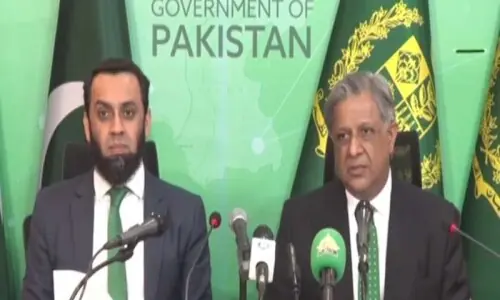
“The ceasefire is not holding because the ceasefire was about ceasing terrorist attacks inside Pakistan by the [Tehreek-i-Taliban Pakistan, Fitna-al-Khwarij] and Afghan nationals using Afghan soil,” FO spokesperson Tahir Andrabi said at his weekly press briefing.
The truce, reached after October’s border hostilities, was formalised during Doha talks co-mediated by Qatar and Turkiye from Oct 18 to 19, and later reaffirmed in follow-up rounds held in Istanbul.
But nearly six weeks on, officials say the situation has deteriorated with Pakistan recording about 20 terrorism incidents traced to Afghanistan including the attacks in Islamabad and Peshawar as well as thwarting at least three TTP border-incursion attempts.
‘Not a typical ceasefire’
The spokesperson underscored that the understanding between Islamabad and Kabul was not a typical ceasefire between two warring states.
The Pakistan-Afghanistan ceasefire implied that there would be no terrorist attacks by Afghan-sponsored proxies into Pakistan. There have been major terrorist attacks after this ceasefire,” he said.
“So, if Afghan nationals are continuously attacking, as they did so in Islamabad and elsewhere, then we cannot be very optimistic about the ceasefire.”
He said Pakistan’s security forces were fully prepared to respond to any threat.
“As regards the threat you mentioned from Afghanistan, our security forces remain fully alert. Our military preparedness is robust. The security challenges we face would be addressed with the seriousness that they merit.”
These remarks come amid rising tensions between the two neighbours.
Security sources say the army has moved additional military hardware to sensitive positions along the Afghan frontier, warning the situation could escalate. Surveillance on all border approaches has been tightened.
The spokesperson also called for stronger regional cooperation against terrorism.
“Joint coordination needs to be enhanced in days to come because this menace is growing and is reaching, as we mentioned, across national, transnational proportions,” he said.
Tajikistan attack
This reference seemed all the more poignant in the wake of a drone-and-firearms attack, launched from Afghanistan a day earlier, which struck a Tajik-Chinese gold mining site in Tajikistan’s Khatlon province, killing three Chinese workers.
This was the second fatal attack on Chinese nationals in Tajikistan this year.
In an earlier statement, the FO said that the use of armed drones in the incident underlined the “gravity of the threat emanating from Afghanistan and the brazenness of those behind it”.
“As a neighbour that has repeatedly suffered terrorist attacks orchestrated from Afghan soil, the people of Pakistan fully understand and share the grief and anguish of our Chinese friends and Tajik partners,” it said.
The statement touted the attack as a vindication of Islamabad’s stance, saying: “Pakistan has consistently stressed that Afghan territory must not be used for terrorism against its neighbours or any other country. The repeated use of Afghan soil by terrorist elements and their continued presence under the patronage of the Afghan Taliban regime, is a matter of serious concern for the entire region and the wider international community.”
In his briefing, the spokesperson said Pakistan planned to draw on its bilateral channels, including security dialogues with Tajikistan and China as well as established trilateral contacts among the three countries, to strengthen counterterrorism cooperation.
He added that Islamabad was also using multilateral forums, pointing to Pakistan’s current chairmanship of the SCO’s Regional Anti-Terrorist Structure.
Coordination with the United States, he noted, also remained active. “Pakistan and the US are in the UN Security Council, where this issue is discussed in the relevant counter-terrorism committees of the Security Council. So, we have multiple platforms to discuss and to follow up on these issues,” he added.
‘Outrageous’ claim
The spokesperson was also questioned about allegations from the Afghan Taliban about Pakistan harbouring the banned militant Islamic State (IS) group, to which he responded that it was an “outrageous” claim.
“It is a figment of the imagination of the Afghan Taliban regime. Afghan side wants to externalise this menace of terrorism, which inherently is on their own soil and of their own making. They want to externalise it to Pakistan, naming various organisations. Any extremist terrorist element in Pakistan is treated, is dealt, as per our laws. This statement, of presence of any [IS] in Pakistan is totally baseless.”
With input from APP
Published in Dawn, November 29th, 2025
Baqir Sajjad Syed is the Foreign Affairs and National Security Correspondent for Dawn. His career of over 25 years spans print and broadcast journalism. He is a former UN Reham al-Farah Fellow and held a Pakistan Fellowship at the Woodrow Wilson Centre in Washington, DC. He can be found on X at @baqirsajjad.