0
0
• Iranian official acknowledges Pakistan’s ‘vital role’ in regional security
• Both countries to use each other’s currencies to boost trade
ISLAMABAD: Top Iranian national security official, Ali Larijani, wrapped up his two-day visit to Pakistan on Wednesday, stressing Islamabad’s “crucial role” in regional peace and stability and calling for practical steps to deepen bilateral cooperation.
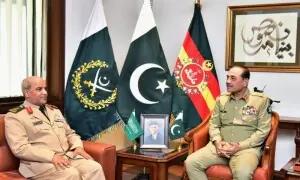
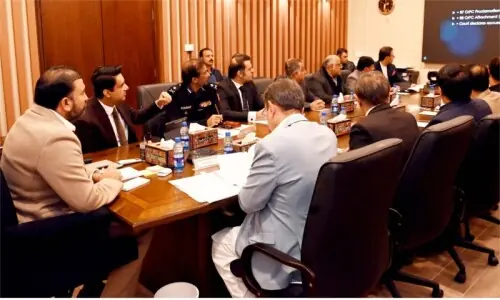
On the final day of his trip, the secretary of Iran’s Supreme National Security Council met Chief of Army Staff (COAS) Field Marshal Asim Munir at GHQ, and later held talks with national security adviser and intelligence chief, Lt Gen Asim Malik.
According to the military’s media wing, the discussions at GHQ “focused on regional security issues and bilateral cooperation”.
Inter-Services Public Relations said both sides reviewed “the prevailing security dynamics in the region”, and quoted FM Munir as reiterating Pakistan’s commitment to peace and the need for “closer collaboration with Iran to combat terrorism”.
‘Vital role’
Mr Larijani, it said, acknowledged Pakistan’s “vital role” in maintaining regional security.
Shortly after the GHQ meeting, Mr Larijani posted a strongly worded message on X, saying: “The Americans try to portray themselves as the turning point of every global development, but this is a form of self-deception. We accept genuine negotiations, not artificial ones, And the outcome of any negotiation must not be predetermined.”
He had delivered similar remarks a night earlier while meeting Pakistani scholars, but the timing of his post, shortly after meeting the army chief, was widely noted.
Mr Larijani’s comments echoed the position of Iranian Foreign Minister Abbas Araghchi, who said in Tehran that Iran wanted a “fair and balanced deal”.
Boosting trade
Speaking to reporters at the Iranian embassy, Mr Larijani said, “Pakistan and Iran have agreed to use national currencies for trade between the two.”
He added that “both Pakistan and Iran are determined to bring peace and establish peace and security at the borders”.
“Officials say that counterterrorism cooperation between the two neighbors has expanded in recent months, as groups such as Jaish al-Adl and the Balochistan Liberation Army exploit the 900km border to carry out attacks on both sides.
During President Pezeshkian’s visit to Islamabad in August, both countries agreed to joint border patrols, intelligence sharing, and closer military coordination to dismantle cross-border militant networks.
Backchannel role
Throughout his engagements in Islamabad, Mr Larijani underscored that Pakistan’s support for Iran during the 12-day Iran-Israel conflict had been “principled”, reaffirming Tehran’s confidence in Islamabad’s role as a messenger between the rival sides.
Pakistan has been quietly relaying messages between Iran and US since the collapse of Washington-Tehran talks previously hosted by Oman, according to officials privy to the process.
Its role has centered on conveying signals on restraint and de-escalation.
Last week, French publication, Intelligence Online, reported that COAS Munir, who “built a relationship of trust with the Trump administration during spring tensions with India”, has now been asked by Washington to assist on “the Iranian issue”.
Some unverified reports suggested a senior Pakistani official, possibly the army chief himself, travelled to Abu Dhabi on Wednesday afternoon after Mr Larijani’s visit to GHQ — a move observers linked to Islamabad’s backchannel role.
These reports could not be independently confirmed, and ISPR did not respond to a query about the high-level visit to Abu Dhabi.
Mr Larijani said Tehran was open to further diplomacy but not desperate for talks. On the possibility of renewed contact with the US, he said: “The Islamic Republic of Iran is not insisting.”
The Iranian security official said efforts to expand bilateral cooperation were a key focus of his talks in Islamabad. In a post on X, he wrote: “I informed Pakistani officials that President Dr Pezeshkian, following his visit to Pakistan, has issued important directives to remove the economic barriers between the two countries.” He said the Supreme National Security Council would also lift any restrictions in this regard. “We do not impose any limitations on cooperation with Pakistan. However, greater dynamism and practical action are needed. It was agreed that robust mechanisms would be established to follow up on these matters,” he continued.
Published in Dawn, November 27th, 2025
Baqir Sajjad Syed is the Foreign Affairs and National Security Correspondent for Dawn. His career of over 25 years spans print and broadcast journalism. He is a former UN Reham al-Farah Fellow and held a Pakistan Fellowship at the Woodrow Wilson Centre in Washington, DC. He can be found on X at @baqirsajjad.