Musadik warns of climate-driven devastation facing Pakistan
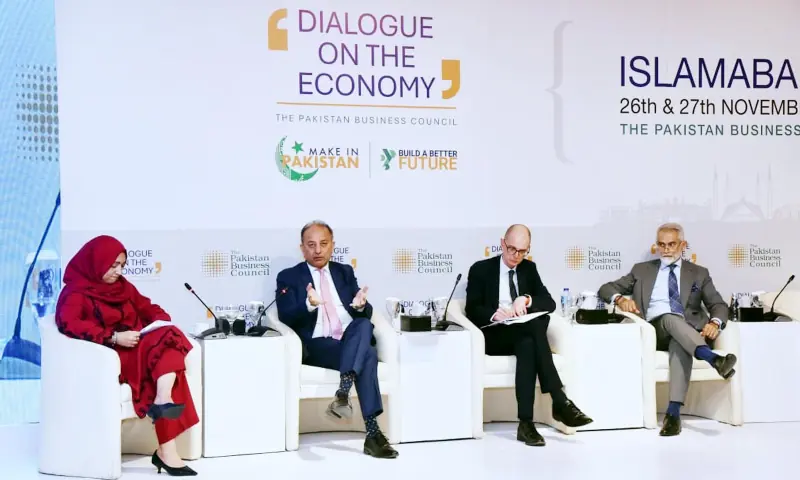
ISLAMABAD: Federal Minister for Climate Change Senator Musadik Malik on Wednesday delivered a stark warning, urging policymakers, businesses and international partners to confront the “true magnitude” of the climate-driven devastation facing Pakistan.
He was speaking at the Pakistan Business Council (PBC), which opened the 4th edition of its two-day Dialogue on the Economy 2025 in Islamabad.
The event also marked PBC’s 20th year of impact in shaping Pakistan’s business ecosystem and bringing together senior ministers, policymakers, economists, global partners and corporate leaders to reflect on the country’s economic direction.
Organisers said Pakistan’s economy was at a point where clarity, predictable reforms and stronger institutional collaboration were essential.
Set against this backdrop, PBC’s two-decade legacy of evidence-based advocacy framed the discussions on competitiveness, investment, policy alignment and the role of responsible business in national progress.
Speaking at a climate and business resilience forum, Musadik Malik said the scale of recent disasters raised a fundamental question: “What is more devastating, war or climate?”
He informed the gathering that during Pakistan’s last four major floods, between 4,600 and 4,800 people lost their lives, more than the casualties seen in many conflicts.
Another 18,000 people were injured or permanently disabled, while nearly 40 million Pakistanis were displaced.
Using a humanitarian lens alone, he said, the burden was staggering. “In the most recent flood, nearly three million people were uprooted, half of them school-going children. Imagine more than a million children missing two to three months of school,” he said. “That adds up to nearly 120 million lost school days in one event, and that wasn’t even the worst flood.”
The minister also underscored the economic shock of recurring climate disasters. The 2022 floods alone caused losses equal to 9.8 per cent of Pakistan’s GDP, wiping out years of economic progress. Across the last four major floods, damages ranged between 1.5 and 9 per cent of GDP. “So even if we don’t humanise the discussion and only talk in nickels and dimes, the cost is unbearable.”
He warned that Pakistan’s geography, sitting below Himalayan glaciers, placed it on the frontline of climate risk. While Pakistan contributed less than one per cent to global emissions, two neighbouring countries collectively accounted for nearly 40 per cent.
Meanwhile, he added, “Ten major emitters receive 85 per cent of global green financing, leaving developing states to face rising losses with limited support.”
Beyond floods, Musadik Malik pointed to worsening smog, crop-cycle disruption and looming food insecurity. Glacial melt threatened irrigation systems, while erratic rainfall had left farmers unable to predict sowing seasons. “Climate is also food security,” he said, warning that a population of 240 million would face a growing strain.
Sam Waldock, Development Director at the British High Commission, echoed the concerns, noting that climate inaction now directly affected business operations. Recent research, he said, estimated displacement costs at $80 billion, invisible asset losses at $100 billion, and agricultural damage at $200 billion.
“Doing nothing is no longer an option,” he said, urging companies to integrate climate risk into decision-making, adopt resilience-based planning and tap emerging climate-finance tools.
The PBC also announced a Climate Risk Awareness Toolkit to help smaller firms assess their vulnerabilities.
Published in Dawn, November 27th, 2025