0
0
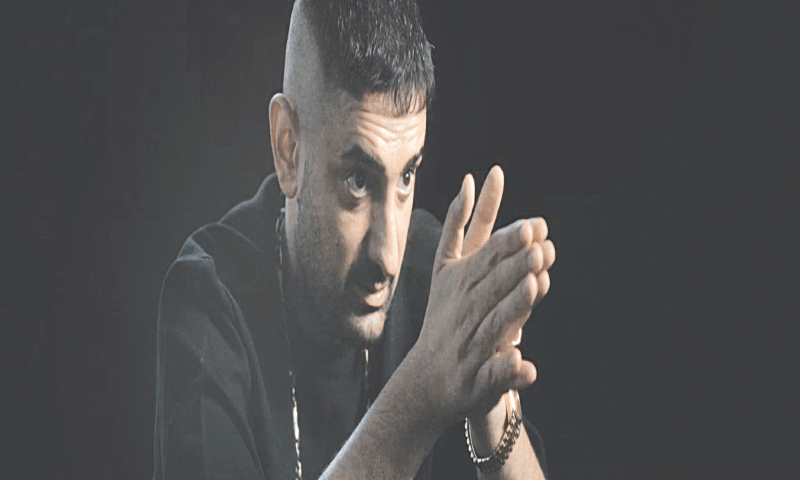

In the new documentary, Babo: The Haftbefehl, viewers watch the gifted yet controversial German rapper Haftbefehl almost destroy himself with cocaine. The documentary, which follows both his huge success and his personal crises, has become the most-viewed film on Netflix Germany — a sign of what gets the country talking.
Haftbefehl (literally meaning ‘arrest warrant’) is one of Germany’s most famous rappers. He’s known for his brutal and drug-glorifying lyrics. Born Aykut Anhan, he is the documentary’s titular ‘Babo’, a formative figure in German-language rap. Babo — slang for ‘boss’ or ‘leader’ — has been Haftbefehl’s self-proclaimed nickname ever since his breakthrough song Chabos Wissen Wer Der Babo Ist (Chabos Know Who the Babo Is — ‘chabos’ is Romani for boys).
Some consider him a gifted artist whose command of the language has shaped an entire generation in Germany, or a role model, particularly among people with a migrant background. Some student representatives have even urged that Haftbefehl’s lyrics be incorporated into school lessons.
Babo is the Netflix documentary that is forcing Germany to confront race, class and the cost of fame
Others see him as a misogynist and anti-Semite because of some of his lyrics. But admirers and critics alike are now taking part in a broader, and unexpectedly fruitful public conversation. From the culture pages of major newspapers to office small talk and TikTok, people are suddenly talking about systemic racism, drug-fuelled decline, and what counts as art. As linguists and rhetoricians interested in researching common ground, this debate has drawn our attention.
Haftbefehl the orator
In his albums, Haftbefehl raps about growing up as a drug dealer in the housing projects of Offenbach, a city near Frankfurt am Main; about his own drug use; and about his meteoric rise to rap superstardom. On the surface, his lyrics follow a street-rap formula, full of familiar hip-hop clichés, but there is more to Haftbefehl’s writing.
His style is shaped by the way he switches between languages and registers, amplifying the force of what he says: “Das ist kein Deutsch, was ich mache, ist Kanaki.” (“What I’m doing isn’t German, it’s Kanaki” — Kanaki is his signature slang style). Such multi-ethnic youth varieties of the German language should, as research suggests, no longer be regarded as a sign of a lack of integration, but rather as a dynamic dialect.
Threading Turkish, Kurdish and Arabic expressions into German lyrics, he reaches listeners on the streets as well as middle-class teenagers in their bedrooms. No wonder then that Babo had already been declared the official youth word of the year 2013 in Germany.
Haftbefehl is what rhetorical theory would call an orator. In the documentary, we see a speaker whose power lies in weaving content, character and emotional force into one persuasive story.

His message can’t be separated from his image. The emotion in his words and music creates a kind of persuasion that feels lived-in — the mix of tough and vulnerable traits comes across as authentic. Haftbefehl is seen as the ‘Babo’ because his lyrics, sound and personality go beyond what listeners expect, giving them both intense honesty and creative use of language and music.
More and more, however, the documentary shows his severe addiction to cocaine. We hear the rattling and gasping of his breathing and learn how, after an overdose and while still in intensive care, he tore out his tubes and ran off to use again. We also meet other artists, managers and assistants who speak both of his lyrical genius and of his excesses. Anhan is portrayed as a ‘force of nature’ that cannot be contained.
Why does he lay himself so completely bare — presenting himself as a junkie with suicidal impulses, as a bad father, and as the kind of partner nobody would wish for? Anhan himself explains this right at the beginning of the documentary: “Do you know why I’m here? In case something ever happens to me, so that my story will be told correctly. From my perspective.”
All of this culminates in a specifically German discourse, one that Haftbefehl’s story shapes. No one questions whether his story has been told ‘correctly’. But in the documentary’s narrative mirror, we see a problematic figure re-emerge: the romantic genius, tossed between genius and madness.
One scene shows the rapper as a sensitive artist beneath the armour of his superstardom. Haftbefehl plays the production team a song by the German folk singer Reinhard Mey on his smartphone, visibly moved. The song, written over half a century ago, seems entirely out of place within the rapper’s harsh style — and yet he, and along with him the audience, immediately recognise the parallels to the brokenness of his own life.
In the end, the documentary doesn’t so much show us who Haftbefehl is as provide a pretext for talking about him. This makes his story feel like both a warning and a rescue. We learn that both Anhan, the person, and ‘Haftbefehl’, the persona, are pushed into getting help when Anhan’s younger brother tricks him into entering a closed rehab clinic in Turkey.

And when we finally see him at the end — overweight, with a flattened nose from cocaine use and a nervous leg twitch — he talks about how he is keeping up: “I’m doing fine, bro. I was in therapy.” In that moment, the documentary gives us a small bit of hope that his future might turn out better.
The deeper issues behind Haftbefehl’s story, however, only really emerge when people begin to discuss what the documentary leaves out: the absence of his mother, or how racism and class differences affect migrant kids — precisely the kind of work public discourse can do, and the reason we need to study it.
Germany has been split into people who admire Haftbefehl and people who can’t stand him. And yet, by talking about Anhan, the country has oddly been brought together.
The writer is Research Associate in Rhetoric at the University of Tübingen in Germany
Republished from The Conversation
Published in Dawn, ICON, November 23rd, 2025