Traditional fort-like houses in Tirah valley in shambles
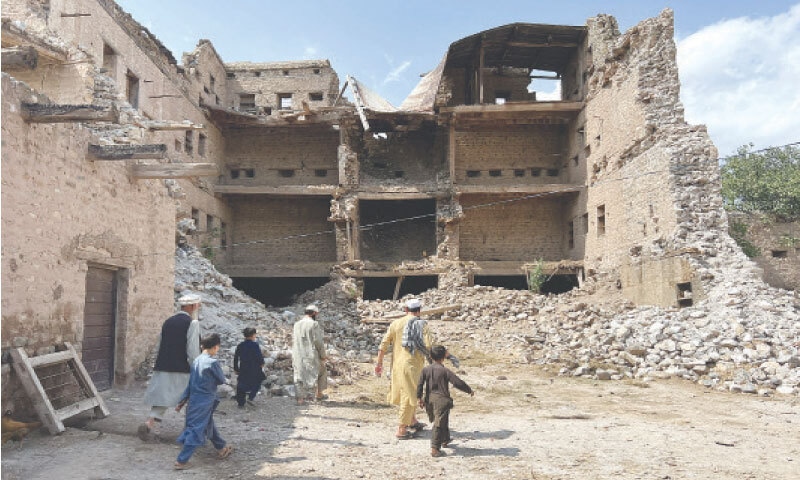
KHYBER: Decades-old traditional houses in Tirah valley, built in peculiar architectural design, are in shambles owing to high cost of rebuilding and continuous apathy of relevant official departments in conducting a realistic survey of the damage these buildings have suffered owing to militancy and military operations in the area.
The exact data of the number of such fort-like houses could not be ascertained as the erstwhile Fata Disaster Management Authority and later Provincial Disaster Management Authority have not yet completed the much-awaited damage assessment survey in most parts of the restive Tirah valley despite repeated reminders by affected families.
With three feet thick outer walls, most of these multi-storey houses are built of mud, stones and timber with limestone also used in some of the structures usually owned by wealthy families. Most of these houses are in square shape. The size of a house was determined by the size of the family.
A number of these fort-like houses also served as a symbol of personal influence of its owner, most of them tribal elders, and also as a reflection of the grandeur and affluent financial status of the family.
Most of these historic structures affected by terrorism, military operations
Famous among these houses were Malak Qala of Malak Ali Akbar, Malak Wali Khan Kukikhel Qala and Nawab Zaman Khan Qala, once considered as power centres of owners but now all lay in shambles owing to aerial bombing.
Locals told this scribe that two to four families would reside in those two or three storey houses with domestic animals, mostly cows and goats, also sharing a portion of the house while one comparatively spacious room would serve as a ‘common room’ where inmates would sit and dine together before going to sleep.
They said that most of those houses were built by their ancestors and the construction and renovation would continue for several decades as they would expand the old structure with increase in the number of family members.
Thordil Khan Zakhakhel of Paindi Cheena told this scribe that his immediate family was the last occupant of a three-storey partially damaged house, which he had inherited from his great grandfather. He said that the front portion of the house collapsed accidentally some 15 years ago, but he wanted to preserve and protect the remaining structure as a historic ‘remnant’ of his family.
He said that there were local expert craftsmen, though limited in numbers, who were employed by owners for building those houses while the younger lot of the family would also work with them to save extra cost.
Mr Zakhakhel said that they would bring stones and rocks from the bed of nearby Bara River and mountain, respectively, while timber was chopped from their joint forests in accordance with the requirement of a new house.
He said that in the absence of electricity, they would light those houses with oil lamps and lanterns at night and would use wood fire for cooking and keeping the structures warm during winters.
He, however, said that most of those historic structures fell victim to militancy and military operations while hostile weather conditions too caused ‘irreparable’ damage to those houses as residents were forced to relocate to camps and safe places during the period between 2012 to 2022.
Haji Waak Khan, a resident of Dray Wandi village in Upper Bara, said that they had a sprawling 18-room fortress-like house, built from stone, mud and precious wood, where he lived for almost four decades with his extended family before being forced to migrate to Peshawar after the start of military operation in 2012.
He said that most of those houses, including his own, were forcibly occupied by militants, especially affiliated with Mangal Bagh-led Lashkar-i-Islam militant group as those houses perfectly catered to their security requirements.
He, however, said that militants’ occupation of those decades-old historic structures exposed them to aerial bombing and artillery shelling by security forces during military operations.
Mr Khan said that apart from natural beauty of the valley, those unique structures too were a hallmark of Tirah and were a source of attraction for tourists and culture lovers.
Mir Ras Khan of Speen Drand village said that precious wood used for doors, windows, pillars and girders in the roofs was mostly stolen by unidentified people after most of those houses were either bombed or had crumbled down due to harsh weather conditions.
“The loss of these historic buildings is huge and seems to be irreparable as most of the owners are not in a position to rebuild these houses while government offers a paltry amount of Rs400,000 for a completely destroyed house which was not enough to even cater for loss of precious timber used in those houses,” he said.
Turab Ali, a Sipah social activist, observed that destruction and gradual decay of those houses not only blemished the natural beauty of Tirah but it also ended a closely guarded architectural civilisation of locals as they now were opting for a different lifestyle, though reluctantly.
Published in Dawn, November 17th, 2025