2
2

Earlier this year, producer, actor, author, columnist and now talk show host Twinkle Khanna made a tongue-in-cheek remark that sparked both laughter and reflection. With her trademark wit, she said that Bollywood might as well replace legendary singers such as Abida Parveen and Reshma with viral sensations such as Dhinchak Pooja.
Her comment wasn’t meant literally, of course — it was sharp satire, a pointed reference to that unfortunate time when Pakistani actors Fawad Khan and Mahira Khan were removed from the posters of Khoobsurat (2014) and Raees (2017) amid rising political tensions between India and Pakistan.
Remember the recent trouble surrounding the release of Fawad Khan’s Aabeer Gulaal (2025) — a film caught in the crossfire of politics and patriotism, questioned simply because of its leading actor’s nationality? Or think of Diljit Dosanjh, who quietly defied the divide by releasing Sardaarji 3 (2025) — with Pakistani actress Hania Aamir — everywhere except India.

Just imagine — what if, after the 1965 war with Pakistan, the Government of India had decided to take similar actions against celebrities who were born on the other side of a once-unified India? What cultural loss would have followed?
In that year, Yash Chopra’s Waqt was released just weeks before the war, and most of its celebrated cast had roots in what later became Pakistan. From the graceful Balraj Sahni and Achala Sachdev to the charismatic Sunil Dutt, Raj Kumar and Sadhana — and, of course, director Yash Chopra himself — all of them came from cities that now lie across the border, from Peshawar to Karachi.
Shashi Kapoor, the youngest of the famous Kapoor brothers, was deeply sentimental about Pakistan. His father, the legendary Prithviraj Kapoor, was born in Lyallpur (now Faisalabad) and his elder brother, Raj Kapoor, in Peshawar.
Many of Indian Hindi cinema’s most iconic stars were born in cities and towns that are now part of Pakistan. The attempt to erase this shared heritage is a wound to the shared cultural heartbeat that once linked Lahore to Lucknow, Karachi to Kolkata and Peshawar to Bombay
Raj, the showman of Bollywood, had a strong connection with Pakistan and he chose a novice Zeba Bakhtiar for Henna (1991), came forward to give Nazia Hassan the Best Female Singer Filmfare Award in 1981 despite the entire Hindi film industry going up in arms, and requested playwright Haseena Moin to write the dialogues of Henna.
One of Raj’s early films, Andaaz (1949), had him share the screen with Dilip Kumar (born Yusuf Khan in Peshawar) and Nargis (born Fatima Rashid in Rawalpindi). Years later, Prithviraj appeared alongside Dilip and Madhubala (born Mumtaz Jahan Begum Dehlavi in Swabi) in the timeless Mughal-i-Azam — a film that symbolised the shared artistic spirit of a once-united Subcontinent.

Dilip, too, shared a deep emotional bond with Pakistan and remains the only Indian actor to have been honoured with the Nishan-i-Pakistan, the country’s highest civilian award.
Every Indian star of the ’50s and ’60s seemed to carry a piece of Pakistan in their hearts. From Prithviraj Kapoor and Balraj Sahni, who shaped an era of idealism, to Rajendra Kumar and Manoj Kumar in the ’60s, the dashing Vinod Khanna and the debonair Feroz Khan in the ’70s, and later the classy Suresh Oberoi (born in Quetta) and Anil Kapoor (whose father was from Peshawar) in the ’80s — Hindi cinema’s lifeblood flowed through artists who had roots in Lahore, Peshawar and Karachi.
The women of that golden age carried the same legacy. From the elegant Kalpana Kartik, Kamini Kaushal, Begum Para and the singing star Suraiya, to the glamorous Sadhana, Babita (mother of Kareena and Karisma Kapoor) and Tabassum, daughter of actor Jamal Ali Hashmi and known to us as Tabu — all were born in Karachi.
The most iconic film of the ’70s, Sholay (1975) was directed by Ramesh Sippy (born in Karachi) and featured supporting actors such as A.K. Hangal and Mac Mohan, both born outside India’s current borders.
Producers such as Gulshan Rai (Deewaar, Vidhata), H.S. Rawail (Mere Mehboob, Laila Majnu), and Govind Nihalani (Aakrosh, Ardh Satya, Hazaar Chaurasi Ki Maa) also hailed from Karachi, Faisalabad or Lahore. Even Hrithik Roshan’s illustrious grandfathers — the visionary producer J. Om Prakash and the gifted music composer Roshan — were born in Lahore and Gujranwala, respectively.
And the list goes on. Supporting actors who gave Indian cinema its strength and substance also came from across the border. I.S. Johar and Kabir Bedi, who later found success internationally, were born in Talagang and Lahore. Unforgettable villains and character actors — Pran (Raka), Amrish Puri (Mogambo), Prem Chopra (Dhanraj Puri) and Kulbhushan Kharbanda (Shakaal) — all hailed from what was once West Punjab.

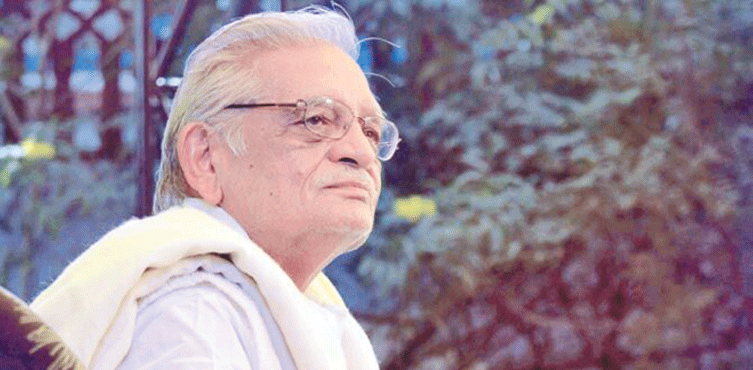
Even the lyricists of the golden age were born from the same soil — one rich with longing, memory and music. Writers and lyricists such as Anand Bakshi, Gulzar, Gulshan Bawra and Shailendra filled their songs with emotions that crossed borders and generations. Their words — full of pain, hope and remembrance — became the heartbeat of Indian cinema. Bakshi and Shailendra came from Rawalpindi, Gulzar from Dina and Bawra from Sheikhupura — all towns that once sang together before lines were drawn upon maps.
In recent years, India’s cultural landscape has increasingly mirrored its political climate, particularly during Indian Prime Minister Narendra Modi’s tenure. The growing tendency to scrutinise or even ban artists associated with Pakistan — be they musicians, actors or filmmakers — reflects the government’s broader nationalist posture.
Can we imagine removing the images and names of the aforementioned actors, directors and producers from their films’ posters — just because the cities of their birth now belong to Pakistan? By that logic, much of India’s cinematic heritage would disappear overnight.
Veteran actor Madan Puri, elder brother of Amrish Puri, is said to have whispered “Keamari... Clifton” on his deathbed, as was mentioned in a book written by his son as a heartfelt tribute to his father. When his son asked what the words meant, his mother explained that, before becoming a film star, Madan had worked as a bus conductor in Karachi and, in his last moments, he was remembering those carefree days by the sea — a place that lived forever in his heart.
In fact, Manoj Kumar, the ever-patriotic Mr Bharat, had roots in Abbottabad. His birthplace was later changed to Amritsar, to make him seem ‘more Indian’. Yet, beneath that quiet correction lies a truth: identity, like art, cannot be restricted by borders.
Under Modi’s cultural narrative, the idea of Indian-ness has become narrower — defined more by exclusion than by exchange. The silencing of artistic collaboration between India and Pakistan is not just a diplomatic after-effect: it is a wound to the shared cultural heartbeat that once linked Lahore to Lucknow, Karachi to Kolkata, and Peshawar to Bombay (Mumbai).
What was once a living, breathing dialogue through art, music and cinema now echoes with silence. It is time to revive that spirit because, if we continue down this path of isolation, Raj Kapoor’s wistful wish of being cremated with mitti [soil] from Peshawar on his forehead feels like a distant dream.
Published in Dawn, ICON, November 9th, 2025