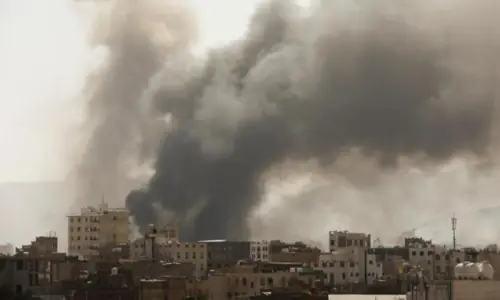
PAKISTAN, seen as the land of waters, is, in fact, strewn with obstructed, polluted and abandoned water bodies. Almost all of its 19 Ramsar sites — wetlands of international importance designated as such under the Ramsar Convention — are ecologically impaired. For three-quarters of the year, the Indus delta, which is recognised by the WWF as a priority ecoregion in its Global 200 initiative, does not receive even the minimum amount of water (environmental flows) required to sustain its health. Pristine lakes have become contaminated bowls. The Indus, one of South Asia’s longest rivers, is imperilled by frequent obstructions, diversions and pollution. The principle of considering water bodies as living beings is thus violated.
Rivers are now being recognised and respected as living beings. Seen as the harbingers of life, rivers are a vital organ of our ecosystems. So far, 369 initiatives have been propagated for granting rights to nature — no longer considered a weird idea as rivers have already been granted legal rights in New Zealand, India, Bangladesh and some other countries.
In 1972, law professor Christopher Stone of the University of Southern California propounded the idea of vesting legal rights in natural objects. An unusual dream, it has now turned into reality in several countries. As of June 2023, the UN Harmony with Nature initiative had listed 30 countries with existing and proposed laws and policies on the rights of nature.
In 2008, Ecuador became the first state to include the ‘rights of nature’ in its constitution. The constitution recognised the rights of ‘Pachamama’ (Mother Earth) to “maintain and generate its cycles, structure, functions and evolutionary processes”. Following in Ecuador’s footsteps, in 2010, Bolivia adopted the ‘Law of the Rights of Mother Earth’, followed by the ‘Framework Law of Mother Earth and Integral Development for Living Well’.
Rivers are now being recognised as living beings.
In 2017, New Zealand set a new benchmark as the first country to give a river — the Whanganui — legal personhood. In the same year, the Ganges and Yamuna rivers were granted living-person status in India, effectively treating injury to rivers as injury to human beings. Later on, the Indian supreme court quashed the verdict based on the lack of practical application of the ruling. Also in 2017, Madhya Pradesh recognised the Narmada river as a living entity, in consideration of its religious significance and its importance for potable water and agriculture.
In 2019, the high court division of the Bangladesh’s supreme court ruled that the Turag river was a living entity and granted it legal personhood. The same status was extended to all rivers in the country. The court decreed that rivers be protected from pollution and encroachment.
In 2017, the Victorian government in Australia passed the Yarra River Protection Act to recognise the river as a living entity. Victoria adopted new legislation that recognised all waterways as living entities.
In Canada, the Minganie Regional County Municipality and the Innu Council of Ekuanitshit recognised the Magpie river as a legal person, granting it nine rights, including the rights to exist and flow. Meanwhile, Colombia’s Atrato river was granted the right to protection, conservation, maintenance and restoration. More significantly, it was accorded the right to have a legal guardian based on the decision of the constitutional court of Colombia.
Against this backdrop, the Indus river system merits a comprehensive appraisal. The environmental fragility of our aqua ecosystem tumbled below the critical threshold long ago. The Indus delta has been degraded to irreparable levels. In 2005, a panel of international exp-erts prescribed a minimum daily flow of 5,000 cusecs to maintain its ecological health. The panel also recommended a flush flow of 25 MAF once every five years. However, the minimum environmental flows are missing below Kotri Barrage except during the monsoons. Ironically, they are demonised as wastage of water due to lack of environmental literacy.
France recognised environmental flows in 1984 when it legislated for habitat protection through the legal minimum flow for existing and new dams under the French Environmental Code of 2000. The UK also recognised environmental flows as “minimum acceptable flows” under the Water Resources Act. Germany, too, made minimal flows for ecological consideration mandatory in 2010. The Swiss Residual Water Regulations provides assurance of adequate residual flow in a watercourse. In the US, the Connecticut legislature passed a law to protect environmental flows in 2005.
Pakistan should also adopt legislation for the rights of nature and instal environmental safeguards for its freshwater bodies and the Indus delta.
The writer is a civil society professional.
Published in Dawn, October 21st, 2025