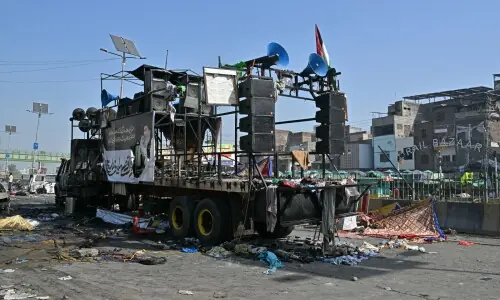
THE state’s crackdown on the TLP is in full swing. On Monday, members of the far-right party and LEAs clashed in Muridke, as the state aborted the group’s attempt to march on Islamabad, apparently to protest in front of the US embassy in ‘solidarity’ with Gaza.
From then onwards, the TLP’s leaders have reportedly gone underground, thousands of supporters have been rounded up, while the group’s mosques and madressahs are being seized by the state. Unlike previous clashes between the TLP and the government, this time it appears that the rulers aim to dismantle the religiously inspired party permanently. On Friday, the Punjab information minister said the summary to ban the TLP had been sent to the centre. Earlier, several federal ministers said that the crackdown would not relent. This would be the second ban in the TLP’s turbulent decade-old history.
However, simply publishing a notification in the official gazette may not be enough to deal effectively with the TLP phenomenon. In Pakistan’s history of far-right religious activism, most sectarian and jihadi groups have belonged to the Deobandi or Ahle Hadith schools, while there have also been a few prominent Shia militant groups.
The TLP, meanwhile, represents the Barelvi school, and has used emotive topics such as blasphemy and other sensitive religious issues to mobilise the public. Its history is certainly problematic. It has on numerous occasions clashed with the law, while its role in organising mobs has also been troubling.
Moreover, it has supported violent campaigns against minority groups, including Christians and Ahmadis, particularly in Punjab, targeting the places of worship of these communities. The TLP is also a major political force, getting millions of votes in the last general elections. Therefore, while an official clampdown may provide temporary relief, it might not produce long-term results.
Banning groups in Pakistan has not proved effective in countering extremist violence. For example, the first major bans were put in place during the Musharraf regime. Many of the groups remain active more than two decades after they were ‘banned’, changing their names several times.
If the state really wants to address the issue of the TLP and other violent groups, instead of bans, it should focus on prosecuting the leaders and activists who promote and participate in violence and who actively engage in hate speech. Because the state has been weak thus far in enforcing the law, powerful violent groups have gained the confidence to continue with their disruptive activities. Groups must be free to organise, but no one can be allowed to advocate violence against any community, or endorse hate speech.
Moreover, protests must remain peaceful. If the state ‘bans’ groups, then loses interest and starts looking away, these outfits will re-emerge, and the cycle of violence and confrontation will continue in perpetuity.
Published in Dawn, October 18th, 2025