0
0


THE atomic mushroom cloud has changed shape: it is now a nuclear umbrella. Historically, an umbrella has symbolised ‘protection, power, and prestige’. (The Thai king has nine above his head.) It is now a warning: Noli me tángere/ Do not touch me. Or if you do, it is at your peril and cost.
During wartime, self-interest drives countries to become allies. In 1939, Stalin’s Soviet Union entered into a non-aggression pact with Hitler’s Germany. Hitler’s invasion of Russia in 1941 put paid to that.
In August 1945, the Soviet Union and the US-backed government of Chiang Kai-shek signed a treaty against Mao Zedong’s Communist PLA. After Chiang Kai-shek’s flight to Taiwan, Stalin switched sides and signed a fresh agreement with Mao.
In August 1971, Mrs Indira Gandhi threw her father’s non-alignment to the winds and sought Soviet support as pre-emptive protection against Nixon’s tilt towards Yahya Khan. To counter it, she signed the Indo-Soviet Treaty of Peace, Fri-endship and Cooperation. The Soviets agreed to “provide arms and guarantee a mutual defence”. This 20-year treaty outlived her. It died when the USSR did, in 1991.
SMDA mimics Nato’s umbrella obligations.
The most durable and sinister mutual defence pact of modern times has been Nato’s treaty of 1949. Under its Article 5, if any Nato member country is attacked, “each and every other member of the Alliance will consider this act of violence as an armed attack against all members [emphasis added]”. They are bound to assist the ally attacked. Caveat aggressor.
The ongoing conflict in Ukraine between Putin’s Russia and the US-led Coalition of the Willing binding 31 countries, plus US’s unequivocal support for Israel, has demolished the centuries-old Westphalian concepts of territorial integrity and national sovereignty. Gone is the gossamer ‘equilibrium of power’. Instead, there is unbridled ‘supranational authority’ in each hemisphere.
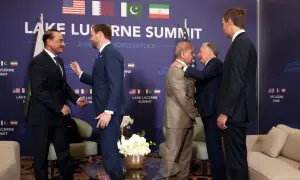
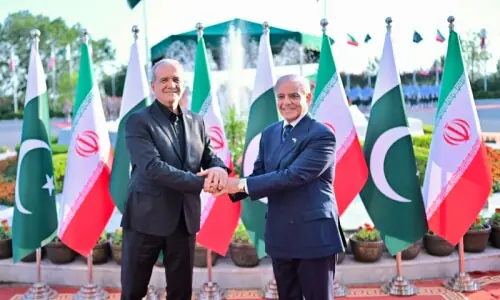
Peripheral countries are left to scramble for ‘friends, not masters’. That explains Saudi Arabia’s hurry to sign a Strategic Mutual Defence Agreement (SMDA) with Pakistan on Sept 17, 2025. The agreement mimics Nato’s umbrella obligations. It provides that any aggression against either country shall be considered aggression against both. Vulnerable others can join this alliance in the future. Its doors are ‘not closed’.
Both parties to the SMDA have emphasised that it is not a knee-jerk reaction to Israel’s recent violation of Qatari airspace. Our defence minister explains that the SMDA is simply the consummation of years of Pakistan’s “military cooperation and brotherly relationship with Saudi Arabia’. If so, why not earlier? If not, why now? Arab nations speak the same language but not all with the same meaning. Unity of action eludes them.
The SMDA is touted as a strategic union. It is premised on fulfilling the parties’ needs reciprocally. Concerned parties have asked whether personnel and nuclear material can be part of a strategic exchange. Saudi Arabia (and any other rich Arab country who joins) has the money to pay. It is seen as a conjunction of interests.
Who will give what or take how much is not disclosed in the SMDA. Pakistan will be expected to do more than simply provide a contingent to protect the Custodian of the Two Holy Mosques, equivalent to the Papal Swiss Guard in Rome. The latter, though armed with ceremonial halberds and swords, could not prevent a Turk from shooting Pope John Paul II in St Peter’s Square in 1981.
PM Shehbaz Sharif and Field Marshal Asim Munir have every reason to feel satisfied. Pakistan is no longer being regarded as a poor supplicant, begging for Saudi dole. It is now the muscled giver, not a flaccid taker. Regardless of the potency inherent in the SMDA which dots the I’s in Israel and India, its efficacy will lie in its application — if Saudi Arabia or Pakistan are attacked.
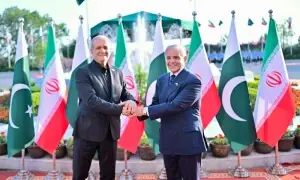
And what does China feel about the SMDA? Cooperation between China and Pakistan has been the bedrock of Pakistan’s security strategy. From the early 1970s (HMC, HFF, HEC) until now (KAMRA, KKH, CPEC, Gwadar, etc), China has helped Pakistan achieve credible self-sufficiency. Added to this, over 80 per cent of Pakistan’s arms imports come primarily from China.
It is inconceivable that Islamabad/ Rawalpindi would not have consulted our ‘iron brother’ in Beijing before the signing ceremony in Riyadh. It would have been as natural as our prime minister flying from Riyadh to Geneva afterwards, to report to his elder brother Nawaz Sharif.
If the obligations under the SMDA are called upon, the axis of power in the region will invoke a wider involvement. In the heat of any conflict — say, another Pahalgam-style fracas or another pre-emptive strike by Israel — the invisible ink in the SMDA would reveal its Pakistan-Saudi-China watermark.
The writer is an author.
Published in Dawn, September 25th, 2025