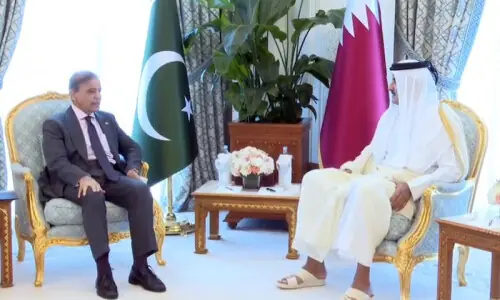
Prime Minister Shehbaz Sharif will be among the attendees of a meeting of “select” Muslim leaders with US President Donald Trump in the coming week on the sidelines of the 80th United Nations General Assembly (UNGA) session in New York, the Foreign Office (FO) said on Sunday.
“The prime minister will also participate in a meeting of select Islamic leaders with US President Trump to exchange views on issues pertaining to regional and international peace and security,” a statement issued by the FO said.
The meeting of Muslim leaders with Trump could be the first instance of PM Shehbaz directly interacting with the US president since the latter assumed the top office in his country in January. Earlier, he met Chief of Army Staff (COAS) Field Marshal General Syed Asim Munir in June, marking the first time a US president has hosted Pakistan’s army chief at the White House unaccompanied by senior civilian officials.
On his visit to New York, the PM would be leading Pakistan’s delegation to the “high-level segment” of the UNGA from 22 September 2025, the FO said, adding that he would be accompanied by Foreign Minister Ishaq Dar, other ministers and senior officials.
At the UNGA session, PM Shehbaz “will urge the international community to resolve the situations of prolonged occupation and denial of the right to self-determination,” particularly in India-occupied Kashmir and Palestine.
“He will draw attention of the international community towards the grave crisis in Gaza and call for decisive action to end the suffering of the Palestinian people,” the FO stated.
“He will also highlight Pakistan’s perspective on the regional security situation, as well as other issues of international concern, including climate change, terrorism, Islamophobia, and sustainable development.”
The FO, in its statement, said PM Shehbaz would attend several “high-level events” on the sidelines of the UNGA session, including important meetings of the UN Security Council, a high-level Meeting of the Global Development Initiative (GDI), and a special high-level event on Climate Action, among others.
Further, during his visit, he will meet several world leaders and senior UN officials to exchange views on issues of mutual interest.
“He will also underline Pakistan’s resolve to work with all UN member states to uphold the UN Charter, prevent conflict, foster peace and promote global prosperity in Pakistan’s current role as a member of the Security Council,” the FO added.
FO highlighted that the PM’s participation in “this biggest annual gathering of global leaders” would showcase Pakistan’s “strong commitment to multilateralism and the United Nations”. It would also reaffirm “Pakistan’s longstanding contribution towards the shared objectives of peace and development,” it said.
Trump’s upcoming meeting with Muslim leaders, including PM Shehbaz, follows significant developments in the Middle East.
Earlier this month, Israel, a US ally, targeted top Hamas officials in Doha, Qatar, killing five of the group’s members and a Qatari security officer.
The attack drew widespread international condemnation, including from Gulf monarchies allied with the United States, which is also an ally of Qatar.
Subsequently, Arab and Muslim leaders called for a review of ties with Israel at an emergency Arab League and Organisation of Islamic Cooperation joint session held in the Qatari capital. The event was co-sponsored by Pakistan. A joint statement from the summit also urged “all states to take all possible legal and effective measures to prevent Israel from continuing its actions against the Palestinian people”.
For his part, Trump — who had a dinner with Qatari Prime Minister Sheikh Mohammed bin Abdulrahman al-Thani in New York following the Israeli attack in Qatar — made careful remarks before the Arab gathering as Washington’s two powerful Middle Eastern allies faced a worsening rift.
The US president had initially rebuked Israel over the attack, saying he was “very unhappy” about it. However, later US Secretary of State Marco Rubio said the US was “not going to change the nature of our relationship with the Israelis”.
Some analysts are of the view that Israeli aggression against Qatar has cast a shadow on US credibility in the Middle East as Arab nations look elsewhere for protection from Israel.
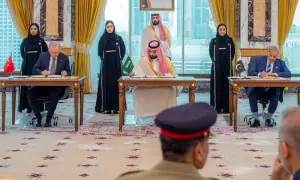
This week, PM Shehbaz and Saudi Crown Prince Mohammed bin Salman signed a “Strategic Mutual Defence Agreement” in Riyadh, pledging that any attack on either nation would be treated as an act of aggression against both.