Israeli strikes on Doha have shattered US credibility. Where do Gulf states go from here?
Israel’s recent strike in Doha crossed a line Gulf leaders had long assumed was sacrosanct: that Gulf capitals were under the American security umbrella and hence outside the operational zone of the Gaza conflict .
Not anymore. Gulf states are now grappling with a new reality: a risk-acceptant Israel willing to reorder the wider Middle East — even at the expense of US allies in the Gulf.
For Gulf leaders, the American inability to restrain Israel is perplexing. More fundamentally, a question looms: can they still trust the US security umbrella in a fracturing region?
Some allies more important than others
As a shocked Qatari leadership processed the strike, it looked to Washington and its Gulf partners for support. The US, meanwhile, issued only a mild rebuke of Israel for hitting another close ally that hosts the region’s largest US base, Al Udeid, home to CENTCOM’s regional headquarters. President Trump promised deeper defence cooperation with Qatar and claimed Doha was given last-minute notice of the strike. Qatar pushed back, terming the notification too late. Trump’s remarks dragged Doha into politically uncharted waters, forcing it to reassert its credibility as a reliable mediator.
For Qatar, the image of the country as a diplomatic mediator has become the lynchpin of its foreign policy in recent years. Israel’s strike on Hamas leaders in Doha struck at the very core of that strategy, shattering the perception of Qatar as a safe and neutral venue for dialogue between belligerents.
For Doha, its role as a trusted broker — backed by US support — has been central to expanding its diplomatic relevance with major powers and securing credibility in international forums. This mediation brand is not symbolic; it is Qatar’s primary tool for offsetting its geographic vulnerability and amplifying its influence in a region where it is dominated by larger neighbours such as Saudi Arabia and the UAE. Yet, now Qatar is looking up to these very regional neighbours to chart a regional response to Israeli aggression.
Realising the gravity of the moment, Abu Dhabi and Riyadh, the regional heavyweights, moved swiftly, framing the strikes as a challenge to ‘collective Gulf security’, not just Qatari sovereignty. This aligns with Article 2 of the ‘Joint Defence Agreement’ of the Gulf Cooperation Council (GCC), which states: “any attack on any of them is an attack on all of them and any threat to one of them is a threat to all of them”.
The real dilemma now is: how to treat an Israeli strike on Qatar as an attack on GCC states, without jeopardising their security cooperation with the US, which was meant to protect them in the first place? An uncomfortable truth is now evident for Gulf states: for the US, some allies matter more than others.
What next for the GCC?
At this point, expressions of solidarity and condemnation are simply not enough. Israel will not be deterred by statements alone, knowing Riyadh and Abu Dhabi remain constrained by their dependence on the US security architecture. Despite their show of support, recent history of Qatar’s tense ties with both the UAE and KSA also weighs on the collective response.
For now, Israel’s reckless behaviour of even attacking those regional neighbours who are facilitating mediation to end the war is hurting the decades-long US security pact with the Gulf states. Among the GCC states, Washington had found a pragmatic partner in Doha, and that collaboration had delivered results in recent years. However, due to Israel’s unhinged risk-taking, both the GCC and the US are now scrambling to restore the credibility of their security cooperation.
The challenge is most acute for Qatar, which must simultaneously restore its security and its standing as a mediator. Within days, Doha moved from mediator to victim.
Drawing on its experience of mediating between the US and the Taliban to end the Afghan conflict, Doha had assumed that Tel Aviv would not strike the very mediator facilitating the only channel linking Hamas, Israel, and Washington.
Qatar’s immediate priority is to raise the reputational cost of any repeat strike while hardening security around negotiations. It is leaning on Washington to restrain Tel Aviv, while underscoring the critical nature of the Doha channel. But trust is absent when Israel appears committed to a military-only path. Beyond mediation, Gulf states, especially Qatar, will now demand firmer guardrails against Israeli aggression and clearer red lines for operations on Gulf soil.
Alternatives to US guarantees do not exist in the short term: Chinese or Russian security patronage is neither feasible nor desirable, and even a regional security architecture involving Egypt, Turkey, or Pakistan cannot function without US assent and participation.
Crucially, the US umbrella was never designed to deter strikes from Israel — a crucial US ally — on Gulf territory. To adapt, Gulf states must develop defensive capabilities outside the US framework while deepening cooperation with regional partners. Early-warning and missile-defence systems from European and Asian suppliers could provide a ring-fence of protection, creating a semi-autonomous shield.
The Doha strike is more than a breach of sovereignty: it is a stress test for the entire Gulf security order. Outrage without deterrence is noise, and the Gulf cannot afford noise.
The signals from the Gulf must be concrete: tighter airspace control, joint threat alerts, and a quiet understanding that any actor striking inside GCC territory forfeits access to Qatar-hosted mediation.
For Washington, the credibility gap is real. If the US cannot restrain an ally from striking another ally’s capital during US-brokered talks, its security protection is not credible anymore. Finally, as the Gulf ponders a regional diplomatic response to avoid becoming next battle space, Qatar faces its own decisive moment: to host, or not to host?
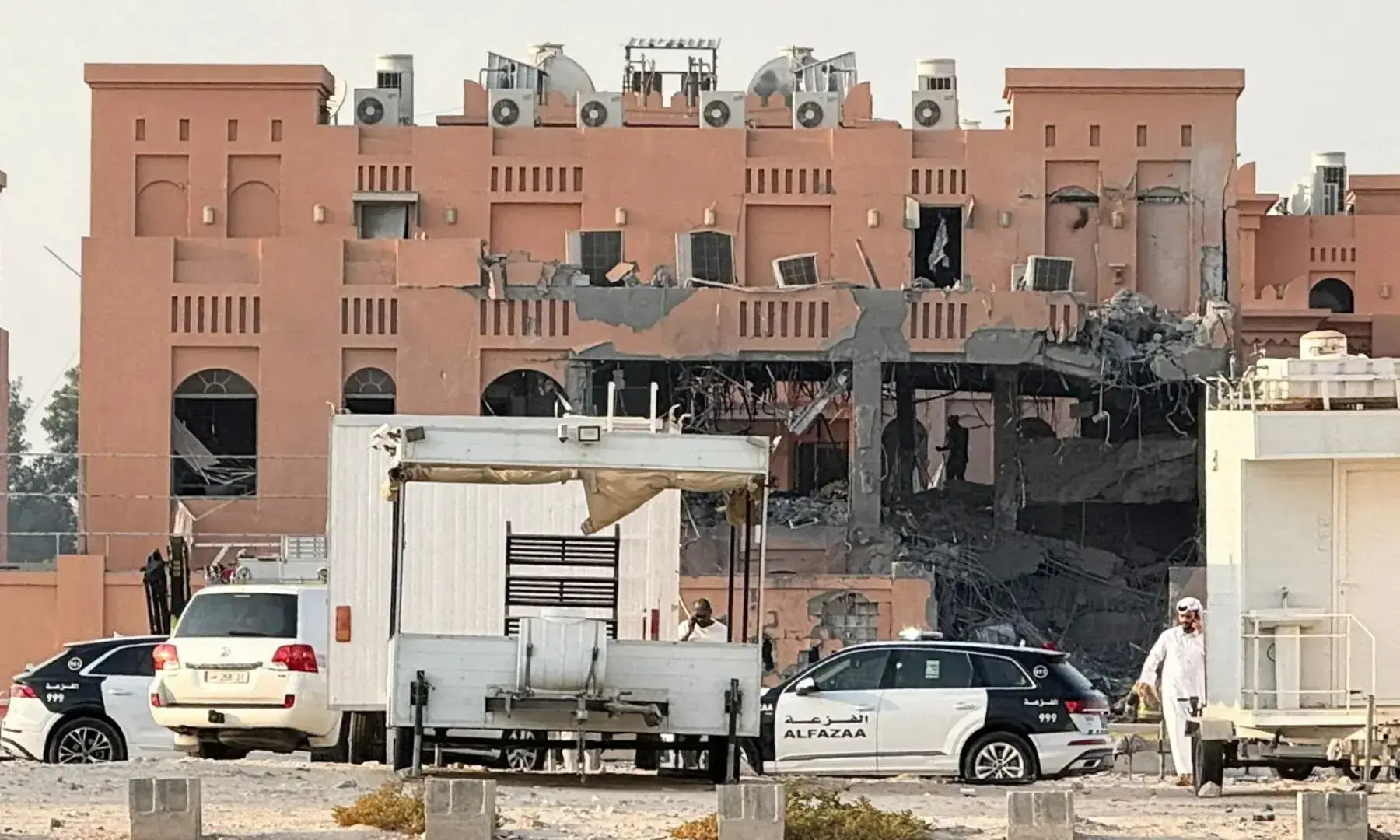
Header image: A damaged building, following an Israeli attack on Hamas leaders, according to an Israeli official, in Doha, Qatar, Sept 9. — Reuters
The author is a South Asia security researcher at the University of Technology Sydney.