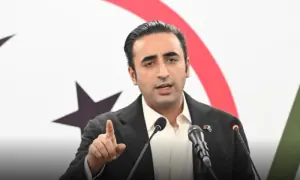
Deputy Prime Minister and Foreign Minister Ishaq Dar on Friday said that Pakistan had not requested anyone to make India sit down for talks of any kind.
“Pakistan did not ask anyone to arrange talks with India. Pakistan is ready for comprehensive talks with India, including on the Kashmir issue,” he told journalists at Parliament House.
Talking about the May conflict between the two countries and the subsequent ceasefire, he said the latter was still underway.
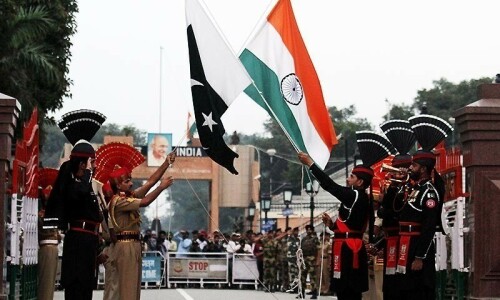
The military confrontation between India and Pakistan came in May as the former, without evidence, linked the Pahalgam attack to Islamabad, which strongly denied the allegations. On the night of May 6-7, New Delhi launched a series of air strikes on Pakistan, killing at least 40 civilians. Both sides then exchanged missiles, which stretched over the week, before a US-brokered ceasefire had both sides agree to stop the hostilities.
Talking about the halt in hostilities, Dar said: “India had requested the US for a ceasefire. I received a call from the US for a ceasefire. I had made it clear that Pakistan did not want war.”
The foreign minister said that Pakistan had been suggested to sit down at a neutral venue for talks, to which he had expressed his willingness to do so.
“I had made it clear that there will be no discussion on any single-point agenda with India. We will discuss all outstanding issues, including the Kashmir issue with India,” he said, adding that “unnecessary rhetoric” continued flowing from India meanwhile.
He also said a visit by US Secretary of State Marco Rubio to Pakistan was not yet scheduled.
Pakistan ready for dialogue with India: FO spokesperson
Foreign Office spokesperson Ambassador Shafqat Ali Khan noted that Pakistan is ready for composite dialogue with India, reiterating remarks made earlier by FM Dar.
Fielding questions from reporters during a weekly press briefing, the spokesperson said Pakistan is ready for “composite dialogue” with India on all matters, not just the issue of terrorism.
“India says that they would talk on terrorism only; however, we want to talk on all matters, including terrorism,” Khan said. “We have complete and detailed evidence about India’s acts of terrorism against Pakistan, but this would just be one item during the composite dialogue.”
Khan added that Islamabad would welcome attempts by other countries, including the United States, to bring Pakistan and India to the table for talks. However, responding to a question, he said there is no meeting in the works between the prime ministers of both countries.
Responding to another question about Indian military buildup, Khan called it an “alarming trend” and a threat to regional stability.
“It becomes more sinister when you look at their declaratory policy, and the domestic developments in India, which are so hostile towards Pakistan, and increasingly Islamophobic,” the spokesperson outlined.
“We have been raising this issue with our partners. The international community turning a blind eye to India’s mad rush to develop their military capabilities is a very dangerous trend.”
However, he assured that Pakistan remains ready and has the capability to respond to any threat or action by India.
Tarar lauds media’s role during conflict with India
Separately, Information Minister Attaullah Tarar lauded the media for its role in countering Indian narratives during the military confrontation and praised it for delivering the country’s message to the world in the face of a much larger media apparatus in India.
Addressing a meeting of the Council of Pakistan Newspaper Editors (CPNE) in Islamabad, Tarar labelled that period as “extraordinary circumstances”.
“Right from the beginning, it was a war of narratives,” he highlighted. “The enemy had greater resources, international interest, lobbying and PR firms. International media outlets had employees of Indian origin because of their greater population.”
The minister stated that Pakistan’s strength was not in numbers or resources, but in “having the truth”.
“The truth cannot hide or be countered,” Tarar stated. “While the prime minister asked for an inquiry into the Pahalgam attack at Kakul, India was levelling allegations without evidence.”
Tarar then described a “synergy” between the armed forces and the information ministry during wartime, noting that the ministry’s “state-of-the-art data centre was maybe made for this purpose so that we could fight a war of narratives”.
He thanked the director general of the Inter-Services Public Relations “for this synergy”.
“This war was fought by everyone together, with your help and your content. The way things were written and disseminated was a team effort,” he stated.
Tarar said that due to the media’s coverage during the fighting, Pakistan experienced a resurgence on the international stage.
“Across the world, people have greater respect for Pakistan and take us seriously,” he said.
“There was this false glorification of ‘rising India’, how it was this big economy and rising power in South Asia. That same Modi has to give fake medals in countries whose names we have never heard of.
“However much factual information we were spreading, they (India) were spreading as many lies,” he added.
“Their media has been terribly exposed, while our media became part of our diplomatic effort and spokespersons for our foreign policy. They took every step for our defence.”
Stating that the Pakistan Navy was ready for any Indian engagement, the minister quipped that “when the enemy found they could not destroy Karachi port, they destroyed ports in Multan and Lahore instead”.
“An Indian channel said that Indian media is a spokesperson for foreign policy and Pakistani media is adrift. I’d like to say to that person that they should be ashamed of the lies and propaganda and how they are being mocked globally,” Tarar stated.
“The whole country played a role in this effort, as did the CPNE, which will be remembered fondly for its role as a wartime body,” he said, stressing the need to acknowledge the CPNE’s “wartime cabinet” and how the council “played a role in narrative building and defeating the enemy during this war”.