Water minister slams India for ‘running away’ from Indus Waters Treaty, rejecting Hague court award


Federal Minister for Water Resources Muhammad Moeen Wattoo on Thursday criticised India for seeking to “run away” from the Indus Waters Treaty (IWT) after its foreign ministry rejected a Hague court ruling to follow the accord in designing new hydroelectric projects on rivers flowing to Pakistan.
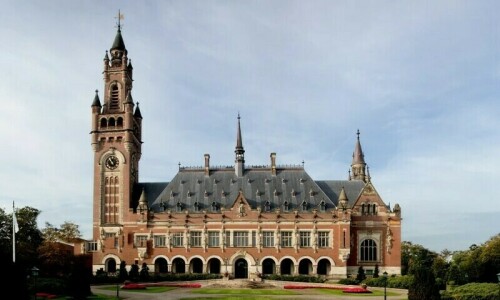
Under the 1960 IWT, three rivers that flow westwards were awarded to Pakistan, with India getting three eastern-flowing rivers. In 2023, Pakistan brought a case to the Permanent Court of Arbitration (PCA) in The Hague over the design of Indian hydropower projects on rivers that were awarded to Pakistan under the treaty.
The court, in its ruling that was posted on its website on Monday, said it had jurisdiction over the dispute and ruled the treaty “does not permit India to generate hydro-electric power on the Western Rivers based on what might be the ideal or best practices approach for engineering” of these projects. Instead, the design of these projects must adhere “strictly” to the specifications laid down in the treaty, the court said, adding that India must generally “let flow” the waters of the western rivers for Pakistan’s “unrestricted use”.
The government had welcomed the decision and Attorney General Mansoor Usman had said the court had accepted Pakistan’s position.
Questioned about the matter today in his weekly press briefing, Indian Ministry of External Affairs spokesperson Randhir Jaiswal said: “India has never accepted the legality, legitimacy, or competence of the so-called Court of Arbitration. Its pronouncements are therefore without jurisdiction, devoid of legal standing, and have no bearing on India’s rights of utilisation of waters.”
He said India stood by its decision to hold the treaty in abeyance.
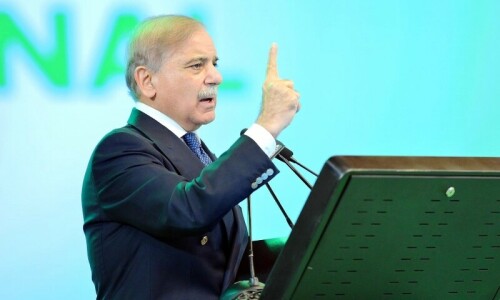
Responding to the MEA spokesperson’s stance, the water minister told Dawn.com: “India wants to run away from this agreement (IWT). Under any article of the agreement, India or Pakistan cannot terminate this agreement.”
He said India’s claim was “baseless and wrong”, adding that Pakistan rejected it.
“The court has already said that it has the power to decide. India had made this claim before, which the court has rejected.”
He said a letter by India earlier in the year seeking modification in the treaty had no legal cover and the country could not unilaterally take a decision regarding the IWT.
India in April held the IWT in abeyance following the attack in occupied Kashmir’s Pahalgam that killed 26 — an incident New Delhi blamed on Islamabad without evidence. Pakistan termed any attempt to suspend its water share an “act of war”, noting the IWT had no provision for unilateral suspension. It later said it was considering court action, citing a violation of the 1969 Vienna Convention on the Law of Treaties.
A supplemental award by the PCA in June held that India could not unilaterally hold the treaty in abeyance. India, in response, said it did not recognise the court or its decisions.
International lawyer Ayesha Malik said India’s stance was a “testament to the extent to which India has departed from being a responsible, law-abiding state”.
She said the PCA award rested on India complying with its obligations under the IWT as well as international law.
“India is choosing to ignore the fact that it cannot merely suspend a treaty like the IWT and act like those obligations are no longer incumbent upon it. Furthermore, it is entirely incorrect for India to say that ‘New Delhi has never recognised the legitimacy of the court’, having entirely recognised its legitimacy in the Kishenganga arbitration of 2013.”
She said the PCA’s appeal for dialogue between the parties in its ruling had “fallen on deaf ears”.
“An increasingly bellicose India under [Narendra] Modi’s Hindutva regime seems to be repeatedly eschewing cooperation in favour of confrontation. While legal wins are good for Pakistan, it seems that its belligerent neighbour does not want the matter settled in a courtroom in The Hague, but by force.”