Commerce minister meets Bangladesh govt adviser to discuss bilateral trade enhancement
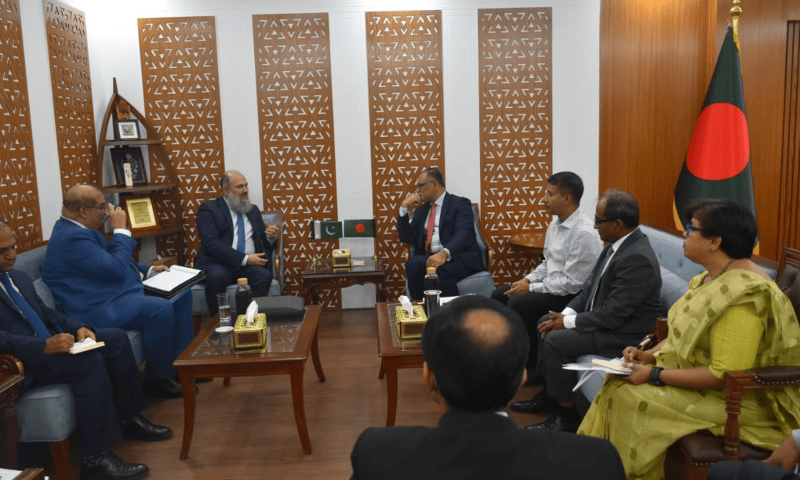


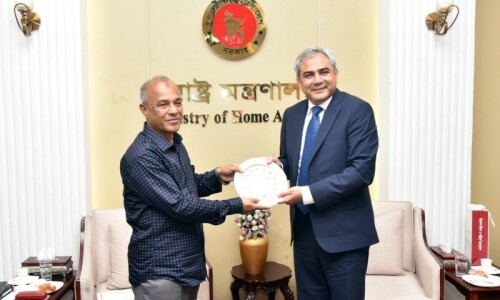
Pakistan’s commerce minister and a Bangladeshi government adviser met in Dhaka on Friday to discuss the enhancement of bilateral trade and the strengthening of economic ties between the two countries.
Ever since a popular uprising in Bangladesh that saw Hasina’s government toppled in August of last year, with the deposed premier fleeing to her old ally India, there has been a thaw in ties between the Islamabad and Dhaka, with trade and bilateral relations seeing a marked improvement.
A press release by the Ministry of Commerce said that Pakistan’s Minister for Commerce Jam Kamal Khan, who reached Dhaka on August 21 for an official visit, met with Bangladesh’s Adviser for Commerce Sheikh Bashir Uddin. During the interaction, both sides “held in-depth discussions in Dhaka today to advance economic cooperation, mutual investments and strengthen bilateral trade ties”.
It added that Pakistan’s high commissioner to Bangladesh, Imran Haider, was also present during the meeting.
“The two countries are in the process of establishing a Joint working group on trade to enhance the economic ties and foster greater cooperation in trade,” the statement said.
According to the ministry, both sides agreed to re-activate the Joint Economic Commission (JEC) forum to work out a comprehensive strategy for the promotion of trade, investment and economic collaborations.
The statement pointed out that the last meeting of the JEC was held in 2005.
The two sides also agreed to form a joint trade commission, which would present a roadmap for building on the existing bilateral trade relations, set goals for future commercial ties and define steps to achieve those targets.
“The minister and adviser discussed sectors including agricultural modernisation, renewable energy, steel industry, green ship breaking, ship building, dates, minerals, construction aggregates, halal trade, sugar, leather, rice, dehydrated fruits and agro-processing,” the ministry said.
The two noted the need to improve and economise connectivity and logistics for trade to cut costs. They also discussed the reduction of tariffs and duties and preferential access to certain Bangladeshi products in the Pakistani market.
Both sides underscored that there was a vast untapped potential of bilateral trade and that both countries were “all set to benefit” from such opportunities.
“The two governments should build on the existing momentum and swiftly move to create a more conducive environment,” the ministry statement concluded.
The commerce minister is currently on a visit to Bangladesh. He was received by Bashir Uddin upon his arrival in Dhaka yesterday.
“Looking forward to engagements with officials and business leaders,” he said on social media.
Yesterday, he held discussions with Bangladesh’s Adviser for Industries Adilur Rahman Khan to explore avenues for industrial cooperation between the two countries. He emphasised Pakistan’s interest in being a part of Bangladesh’s evolving industrial landscape through collaboration, joint ventures and mutual investment.
Separately, Bangladesh Army Quarter Master General Lieutenant General Faizur Rahman called on Chairman Joint Chiefs of Staff Committee (JCSC) General Sahir Shamshad Mirza at the Joint Staff Headquarters in Rawalpindi, according to the military’s media wing.
“During the meeting, both sides discussed the prevailing security environment in the region and laid emphasis on shared resolve for enhancing existing cooperation in defence and security domain,” the Inter-Services Public Relations said in a statement.
“The Chairman JCSC highlighted the rising trajectory of bilateral relations between both the countries and identified new avenues of defence cooperation,” it added.
It concluded that the visiting dignitary “lauded the professionalism of Pakistan Armed Forces and acknowledged their sacrifices in fight against terrorism”.
Meanwhile, the Foreign Office (FO) confirmed that Deputy Prime Minister and Foreign Minister Ishaq Dar will pay an official visit to Dhaka over the weekend on Bangladesh’s invitation.
The FO said he will hold important meetings with various Bangladeshi leaders, including Chief Adviser Muhammad Yunus and Adviser for Foreign Affairs Touhid Hossain.
“The whole range of bilateral relations and a number of regional and international issues will be discussed during these meetings.”