Karachi Press Club: The Island of Truth
By Ashraf Shad
Pakistani Adab Publications
176pp.
You might be a blogger, vlogger, TV host or a critic — but if you haven’t spent time at the Karachi Press Club (KPC), you haven’t truly walked the path of a journalist, as they say. The club isn’t just a building; it’s a rite of passage, a badge that says you’ve earned your place in the field. If you’re curious about what makes it so special, Ashraf Shad’s Karachi Press Club: The Island of Truth is the perfect place to start.
A journalist with decades of experience, Shad has compiled a new book that focuses on one of the most iconic journalistic bodies in the country. The 176-page book, featuring additional archival images, focuses on the experiences, politics and ethos surrounding the KPC.
An activist at heart, Ashraf Shad has authored several books — including poetry and political fiction — but this work is unique: a compilation of first-hand accounts by journalists themselves, with Shad having some 50-odd pages of his own reflections.
The book begins with an interview of Hussain Ahmed, the oldest surviving member of the KPC. Affiliated with the club since the late 1950s, the octogenarian was interviewed by the late journalist Amin Rajput, specifically for this book. Their conversation offers readers a vivid glimpse into the club’s formative years, highlighting its origins and illuminating its storied past.
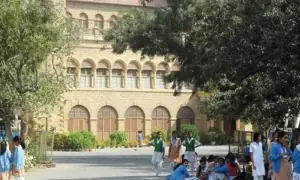
The second chapter, written by Ashraf Shad himself, opens with a vivid portrayal of the KPC’s space and atmosphere. Now based in Australia, he recreates the club’s living spirit: the smoky card games played at midnight, the marquee lunches with senior journalists and the informal debates that helped shape Pakistan’s civic discourse.
A collection of first-hand accounts on one of the most storied journalistic collectives in the country, the Karachi Press Club
Shad also recalls how he used his influence to persuade legendary artists, such as Farida Khanum and Mehdi Hassan, to perform at the club’s premises, while fondly remembering a young Ghulam Ali being asked to fill in for Farida Khanum during her absence.
Central to his narrative is the interplay between media freedom and the club’s institutional resilience. He highlights pivotal events such as the 1970 journalists’ strike, and the detentions and censorship orders that followed, illustrating how the KPC stood as a steadfast locus of resistance against each assault on press freedom.
The Movement for the Restoration of Democracy (MRD) was launched from its premises in the early 1980s, underscoring its role as more than just a communal place for journalists. While authoritarian figures such as Ayub Khan, Zulfikar Ali Bhutto and Gen Ziaul Haq never stepped foot inside, Benazir Bhutto — owing to her activist roots — moved freely in and out of the club, even during her tenure as Prime Minister.

Academic Dr Tauseef Ahmed Khan, along with veteran journalists Mazhar Abbas, Mujahid Barelvi, Fazil Jamili, Shehnaz Ahad and Habib Khan Ghori — the only person to have served four consecutive terms as the club’s secretary — offer a wealth of insight.
Dr Tauseef not only reminisces about his colleagues but also traces the origins of how various spots within the club got their names. With humour and nostalgia, Mazhar recalls Benazir’s enduring reverence for the club. He also turned back the clock to when the Indian cricket team visited the club in 1989. Mazhar Abbas recalls that during the 1980s, the KPC was notoriously labelled “enemy territory” by the Ziaul Haq regime — a phrase coined by Gen Zia’s trusted aide, Lt Gen Mujeeb-ur-Rehman.
Mujahid Barelvi, now marking 50 years of association with the club, reflects on his long-standing relationship with it and his deep friendship with Habib Jalib, popular for his resistance poetry. It was within these very walls, he notes, that Jalib first recited his iconic nazm [poem] “Zulmat ko Zia”, which translates to “Darkness Called Light” but the title was in reference to Gen Ziaul Haq, the military dictator at that time.
Fazil Jamili, the current president of the KPC, also fondly recalls Jalib and their many meetings at the club.
Journalist Shehnaz Ahad contributes a compelling chapter on the contributions of her female colleagues, who stood shoulder to shoulder with their male counterparts during times of protest and political upheaval.
Faisal Sayani, an electronic media veteran, lightens the tone with a humorous and candid perspective on his early impressions of the club, first as a visitor and later as a member.
Karachi Press Club: The Island of Truth is more than a book. It is a tribute and a timely caution. With archival precision and layered storytelling, Ashraf Shad reminds us that institutions such as the KPC are not merely gathering places for journalists but vital pillars of democratic life. To let them fade, he warns, is to risk dismantling the very framework that upholds truth.
The reviewer writes on old films and music and loves reading books.
X: @suhaybalavi
Published in Dawn, Books & Authors, July 27th, 2025