200-million-year-old flying reptile species found in Arizona


 0
0
WASHINGTON: Scientists have unearthed in Arizona fossils from an assemblage of animals, including North America’s oldest-known flying reptile, that reveal a time of transition when venerable lineages that were destined soon to vanish lived alongside newcomers early in the age of dinosaurs.
The remains of the pterosaur, roughly the size of a small seagull, and the other creatures were discovered in Petrified Forest National Park, a place famous for producing fossils of plants and animals from the Triassic Period including huge tree trunks. The newly found fossils are 209 million years old and include at least 16 vertebrate species, seven of them previously unknown.
The Triassic came on the heels of Earth’s biggest mass extinction 252 million years ago, and then ended with another mass extinction 201 million years ago that wiped out many of the major competitors to the dinosaurs, which achieved unquestioned supremacy in the subsequent Jurassic period. Both calamities apparently were caused by extreme volcanism.
The fossils, entombed in rock rich with volcanic ash, provide a snapshot of a thriving tropical ecosystem crisscrossed by rivers on the southern edge of a large desert. Along with the pterosaur were other new arrivals on the scene including primitive frogs, lizard-like reptiles and one of the earliest-known turtles — all of them resembling their relatives alive today. This ecosystem’s largest meat-eaters and plant-eaters were part of reptile lineages that were flourishing at the time but died out relatively soon after. While the Triassic ushered in the age of dinosaurs, no dinosaurs were found in this ecosystem, illustrating how they had not yet become dominant.
“Although dinosaurs are found in contemporaneous rocks from Arizona and New Mexico, they were not part of this ecosystem that we are studying,” said paleontologist Ben Kligman of the Smithsonian Institution’s National Museum of Natural History in Washington, who led the study published in the journal Proceedings of the National Academy of Sciences.
“This is peculiar, and may have to do with dinosaurs preferring to live in other types of environments,” Kligman added. This ecosystem was situated just above the equator in the middle of the bygone supercontinent called Pangaea, which later broke apart and gave rise to today’s continents.
Pterosaurs, cousins of the dinosaurs, were the first vertebrates to achieve powered flight, followed much later by birds and bats. Pterosaurs are thought to have appeared roughly 230 million years ago, around the same time as the earliest dinosaurs, though their oldest-known fossils date to around 215 million years ago in Europe.
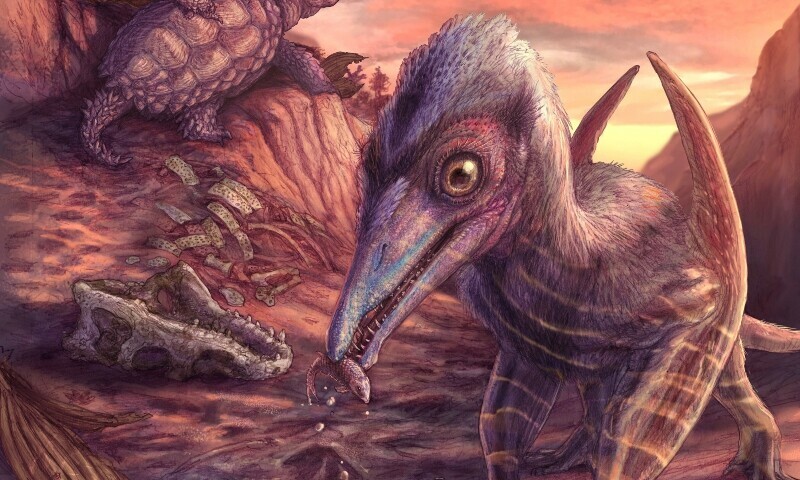
The newly identified pterosaur, named Eotephradactylus mcintireae, is thought to have hunted fish populating the local rivers. Its partial skeleton includes part of a tooth-studded lower jaw, some additional isolated teeth and the bones of its elongated fingers, which helped form its wing apparatus. Its wingspan was about three feet (one meter) and its skull was about four inches (10 cm) long. It had curved fangs at the front of its mouth for grabbing fish as it flew over rivers and blade-like teeth in the back of the jaw for slicing prey. The researchers said Eotephradactylus would have had a tail, as all the early pterosaurs did.
Published in Dawn, July 9th, 2025