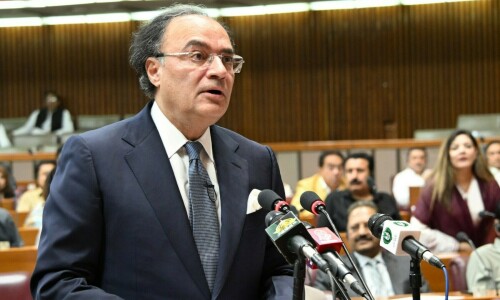
THE budget for the next financial year, announced on Tuesday, seeks to deepen fiscal consolidation in order to pave the way for a successful second review of the $7bn IMF programme in September.
This is apparent from the significant reduction in the consolidated national fiscal deficit target to 3.9pc of GDP from the original target of 5.9pc. The provinces, which have often been criticised for adding to federal fiscal woes because of their increased share under the NFC award, will contribute cash surplus of nearly Rs1.5tr, up 50pc from the Rs1tr they were required to contribute this year to hold down the national deficit.
Indeed, the government has partially met the income tax relief demand from the salaried classes, but the fiscal space for this is basically provided by savings of Rs1tr in debt payments due to reduced domestic interest rates over the last year. These savings have also allowed the authorities to give relief to powerful real estate lobbies demanding tax concessions.
That said, the budget is disappointing for those who thought the economic stability achieved over the last year and a half would encourage implementation of deeper structural reforms for sustainable economic growth.
There is not much in the budget to give hope for such a structural shift. But that does not mean the document is devoid of good points. For example, it sets into motion long-standing tariff reforms that hopefully will end protections to some rent-seeking industries over the next five years.
It also seeks to bring non-filers into the net by imposing restrictions, such as on the purchase of securities above a certain threshold, purchase of autos above 850cc, etc. Moreover, it lays the ground for phased removal of sales tax exemptions for industries operating in ex-Fata/Pata to make the playing field even across the country.
Though the finance minister spoke of the hardships of the compliant corporate sector, his budget speech fell short of addressing the issue of inequitable corporate tax rates, a major obstacle to investment and export growth. While the controversial super tax has been reduced marginally, steps to enhance competitiveness and attract foreign investment are absent.
It is primarily because of unfair tax policies and the burden they put on industry, which forms 18pc of the economy but contributes nearly 60pc to overall tax revenues, that large-scale manufacturing has been contracting.
With the government wanting to boost exports to $100bn in five years under its Uraan programme, the goal is likely to remain elusive without increasing industrial productivity and attracting FDI. Many remain sceptical about the government’s ability to achieve next year’s growth target of 4.2pc, due largely to its failure to change the dynamics of a moribund economy. Stability has returned. Will growth follow suit?
Published in Dawn, June 11th, 2025