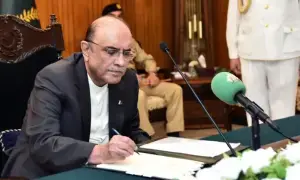
Finance Minister Muhammad Aurangzeb says, “The budget is not just about revenue and expenditure; it has to provide the strategic direction of where the economy is and where it is heading. So it’s our full effort to make this document more strategic, rather than just making the math work.”
However, he maintained that “of course, we have to make the math work” and to make math work, the delay in the budget announcement to June 10 will give the government and the International Monetary Fund (IMF) a little more than a week to settle their lingering differences. This indicates Pakistan’s resolve to reach an agreement with the Fund that it considers more useful rather than agreeing on structural reform details that may be nearly impossible to deliver.
The government is already under pressure from different segments of the population and industry to provide some kind of relief, push economic growth, provide jobs and reduce poverty in order to improve their citizens’ quality of life.
For setting the budget on a well-defined strategic path, it is essential for Pakistan to convince the lender that it should give up micromanaging the country’s economy. The best way to do that is to carry out the agreed macroeconomic reforms agenda, keeping in view the challenging unforeseen domestic and external political, economic and geopolitical shocks. This approach will facilitate any effort towards breaking free from IMF conditions.
To set the budget on a well-defined strategic path, it is essential for Pakistan to convince the IMF against micromanaging the country’s economy
There is already some anxiety in the market, analysts note, regarding the inconclusive talks with the IMF on the government’s budget proposals, especially the ones related to the increase in defence spending, tax relief for salaried individuals and the real estate sector, and cuts in public sector expenditures. The Fund appears, say analysts at Dawn, to be concerned over the hole these steps would create in the budget and wants the authorities to identify alternative sources to cover the gap.
The only hint Mr Aurangzeb has dropped so far about the “strategic direction” concerns plans to expand the restructured debt management office’s goal beyond reducing interest payments and instead create economic value or ‘Alpha’, a term used in finance to describe an investment strategy’s ability to beat the market, to put the economy on a sustainable growth path.
A report by the Policy Research and Advisory Council offers some sobering insight: “Although remittances have grown at a compound annual rate of 6.1 per cent from 2013 to 2023, per expatriate remittance remains low in comparison to other countries in the region.”
“Pakistan’s per expatriate remittance of $2,529 in 2023 remained significantly lower than peer countries — $16,780 for the Philippines, $9,703 for Thailand, $5,914 for Mexico, $4,626 for China and $3,906 for India,” said the report titled Strategic Management of Pakistan’s Forex Reserves: Boosting Exports and Investment Flows.
The remittances, projected at $38 billion for this fiscal year, contribute significantly to managing trade and current account deficits. But these dollars are not being invested to raise productivity in the manufacturing and agriculture sectors and to build a globally competitive economy and boost exports.
The most important strategic measure that the finance minister can introduce is reforms to boost the tax-to-GDP ratio to 18-20pc of the size of the economy
Perhaps the single most important strategic measure that the finance minister can introduce in the budget, say the Dawn analysts, relates to reforms focused on increasing the tax base for boosting the tax-to-GDP ratio to the globally acceptable range of 18-20pc of the size of the economy.
This will not just create fiscal room for raising the defence expenditure and somewhat reduce the tax burden on salaried households and the corporate sector, but also create room to deepen the recent recovery and push the economy towards sustainable growth.
Speaking at another event, Mr Aurangzeb reiterated the government’s position to shift the tax burden away from the salaried class and documented sector to others through digitalisation and hinted at major steps, including compulsory use of digital payments to maximise a cashless economy. Though acknowledging its huge benefits, analysts say digitalisation would be a time-consuming process given the country’s prevailing situation.
To help rebuild trust in the system and make the tax-paying process more transparent, Unilever Chairman Amir Paracha suggests that the Taxpayer Report should show how revenues were used for infrastructure, education, healthcare, and other services.
On the question of providing tax relief to the middle class, Mr Aurangzeb said the government would ensure simplified tax returns and forms for the salaried class. He said that around 70-80pc of salaried people do not hold equity and fixed-income portfolios.
“They receive salaries through bank accounts with tax deducted at source. They should not have to fill in 140-150 data points,” he said, adding that the government aimed to reduce that number to just nine — five for wealth tax and four for income tax.”
Speaking to journalists after an event organised by the Pakistan Bank Association and Karandaaz Pakistan, the finance minister said every possible support would be provided to the armed forces, stressing that it was a national need in light of recent cross-border aggression.
Published in Dawn, The Business and Finance Weekly, June 2nd, 2025