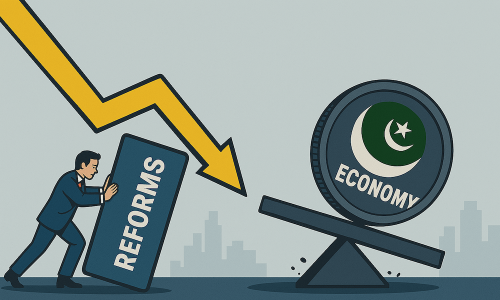
Citizens and entrepreneurs deserve a better deal. Acknowledging deep structural flaws and the need for fundamental reforms, Finance Minister Muhammad Aurangzeb has pledged to make the upcoming budget a strategic document, one that provides clear direction to an otherwise rudderless economy.
Mr Aurangzeb was reported to have remarked in Islamabad last week, “We are going to introduce bold measures; as the budget is not merely about revenue and expenditure, it must also provide direction, reflecting where the economy stands and where it is headed.”
While the statement resonates with the business community, many industry leaders remain sceptical, viewing it as too good to be true. Some are willing to give the government the benefit of the doubt, even as they hold it accountable for stifled growth and, in some cases, mounting losses that have led to unit closures. Others, more cautious and wary of repercussions, declined to share their views publicly. A few, when approached, elaborated on the notion of change, framing it in terms that closely align with their class interest.
In a detailed note on the budgetary direction, the Pakistan Business Council (PBC) outlined key challenges and made a compelling case for reversing what it terms “premature deindustrialisation” in Pakistan.
‘Many of the actions taken by economic ministries are labelled as structural reforms, but in reality, little has changed’
The PBC’s written recommendations, shared by its CEO Ehsan Malik, state in essence: “Pakistan’s key economic challenges remain balancing the external account through higher exports and managing the fiscal account by broadening the tax base, curbing waste, and reforming loss-making state-owned enterprises [SOEs]. For citizens, inflation control, job creation, and socio-economic uplift are vital. The annual budget must address these priorities in a sustained manner to avoid boom-bust cycles through sound fiscal and monetary policies.
“Past budgets have been ad hoc and reactive, lacking alignment with trade, industrial, and investment strategies.” The PBC had earlier proposed long-term reforms, including separating tax policy from tax collection, a move now partially realised with the establishment of a Tax Policy Office. The report went on to highlight that a fair tax system is crucial and that reducing burdens on salaried workers would be a welcome step, as a phased reduction in corporate and super taxes.
Furthermore, the report urged that tariff rationalisation must be paired with reducing the cost of doing business. Deindustrialisation will continue should reforms in energy pricing remain lacking and without capital access and unfair competition from the informal sector. Missteps, like the general sales tax (GST) on local inputs to exporters, have already triggered a surge in imports.
“The imposition of an 18 per cent GST on packaged milk offers a cautionary tale: it led to price hikes, falling sales, a shift to unsafe loose milk, and the closure of milk collection centres, hurting both consumers and formal dairy farmers. Tax policy must avoid penalising the formal sector or undermining long-term growth,” the PBC made a point.
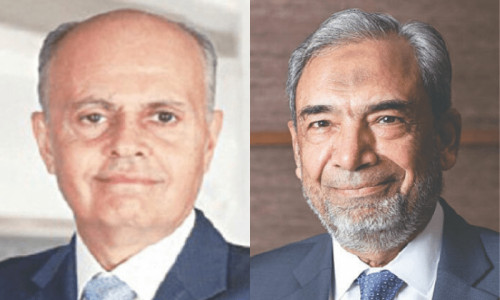
Younus Dagha, former Sindh minister and federal secretary, and current Chairman of the Policy Research and Advisory Council at the Karachi Chamber of Commerce and Industry, questions the government’s claims of a strategic policy shift.
“While the FM’s emphasis on structural reforms in taxation, energy, state-owned enterprises and debt management is commendable, it cannot be considered truly strategic without a parallel focus on human development,” he remarked.
“The most pressing challenge Pakistan faces is unsustainable population growth coupled with minimal investment in human capital. Our massive youth bulge is a ticking time bomb unless we urgently equip the younger generation with futuristic skills through large-scale training and education initiatives.”
Dr Khurram Tariq, former president of the Faisalabad Chamber of Commerce and Industry and current Chairman of textile company Kay & Emms, remains unconvinced by the government’s proclamations. “To be honest, we have yet to witness the so-called ‘shifts’ mentioned in various communiqués from the Ministry of Finance. Many of the actions taken by economic ministries are labelled as structural reforms, but in reality, little has changed. The government continues to follow the same stabilisation-driven path.
“These are extremely challenging times. We fail to understand the logic behind increasing taxes on already-taxed sectors — exporters now face double taxation — and burdening the salaried class. Such measures can hardly be defined as structural changes. Instead of expanding, the tax base is shrinking as high, regressive taxation drives more of the economy into the informal sector. The data clearly shows that the industrial sector is under severe stress,” he added.
Dr Kaisar Waheed Sheikh, former chairman of the Pakistan Pharmaceutical Manufacturers Association and CEO of Medisure Laboratories, noted the disconnect between private sector needs and national budget priorities. He highlighted that while business drives growth, fiscal constraints, corruption, and policy inconsistencies distort outcomes. The 7th National Finance Commission Award has limited the federation’s fiscal space to offer meaningful relief. The pharmaceutical sector, despite rising demand, remains heavily import-dependent. He expressed little hope for major policy shifts but stressed the need for export diversification, particularly in information technology, pharmaceuticals and agro-based goods.
Published in Dawn, The Business and Finance Weekly, June 2nd, 2025