WITH South Asia’s peace balanced on a knife-edge, it is important for national political leaders to remain grounded. In this context, it has been encouraging to see a slight shift in Islamabad’s position on the recent hostilities between India and Pakistan.
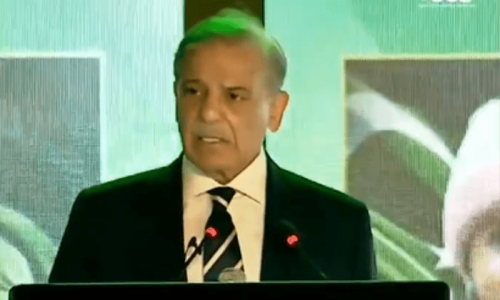
At the start of last week, Prime Minister Shehbaz Sharif had described the recent conflict as having ‘avenged’ the 1971 war — a claim that had startled many even in Pakistan. Towards the end of the week, however, his speeches were more moderate, with the prime minister noting at one point that past wars had given the two countries “nothing but miseries” and that there now needed to be a comprehensive dialogue.
It is encouraging that there is realisation on Pakistan’s side at least that grandstanding on the recent conflict is quite pointless, and that the frictions between the two countries still need to be addressed.
Former foreign minister Hina Rabbani Khar had encouraged much the same in her recent remarks in parliament. Noting that India’s defeat was not a celebratory occasion, she had said, “We must all be unapologetic as a country that celebrates a ceasefire”. After all, death and destruction are never something to cheer. Arguably, it is better not to have a war than to win one. Our political leadership must not forget this.
History shows that states benefit when they are able to escape the unending cycle of hostilities and focus on how they may coexist. Pakistan’s indignation is justified in that it offered India cooperation from the start, but was met with cold rejection. The people also cannot be faulted for celebrating their armed forces’ successful defence against external belligerence. At the same time, however, both Pakistan’s leadership and public must think about how future conflicts may be avoided instead of escalating to the point of all-out war.
It is only fair to expect reciprocity from the other party. The Indian government must realise the folly of a violent confrontation with Pakistan every few years. War is not some theatre with which to keep the public engaged. For better or worse, the two countries are bound by a long border and a shared history and culture. India must realise that it is detrimental for its interactions with Pakistan to be dictated by New Delhi’s constant desire to establish its hegemony in the region.
The recent hostilities have yielded little apart from establishing a dangerous ‘new normal’ that could see more missiles and munitions being traded in future conflicts. What tangible benefit can the people of either country derive from this?
Instead of constantly evoking the spectre of war, the governments of both countries should work towards peace. The people of the subcontinent will one day thank them for it.
Published in Dawn, May 18th, 2025