ISLAMABAD: Deputy Prime Minister and Foreign Minister Ishaq Dar has said a nuclear war was never an option for the government during last week’s escalation with India.
The deputy prime minister, in an interview with CNN, said Pakistan had no choice but to launch strikes in self-defence following cross-border strikes by India on May 7.
Terming India’s strikes “war and a wishful attempt to establish its hegemony in Kashmir,” Mr Dar said Pakistan was “very sure that our conventional capacity and capabilities are strong enough” to beat Indian ground and air forces.
Deputy PM Dar said there was no direct contact between Indian and Pakistani officials before US intervention, contradicting a previous assertion made by India that Pakistan’s director general of military operations contacted his counterpart with an offer for talks.
When asked how the ceasefire deal was reached, the foreign minister said Pakistan’s “counter-escalation” brought world powers into the picture.
After Pakistan’s strikes on May 10, Mr Dar said, “[C]ertain capitals, particularly the US, realised it could be a really filthy next move.”
He claimed to have received a call from Mr Rubio, who had talked to India’s external affairs minister, S. Jaishankar.
“[Mr Rubio] said India is ready to stop it now … Would you be willing? I said of course … if India does not restart [escalations] we would not do it.”
“[The Indians] had seen what happened in the sky. They could see how serious the damage was,” he said while talking about possible reasons for India’s agreement for ceasfire.
Negotiations
Mr Dar said Pakistan was looking forward to establishing a path for long-term peace and security that would provide dignity for both sides.
Calling Kashmir the root cause of this regional instability, Mr Dar called for granting the self-determination right to the Kashmir people. He reiterated that Pakistan was not behind last month’s attack in Pahalgam, saying, “We condemn terrorism in all forms and all manifestations”.
On negotiations with India to resolve longstanding issues, Mr Dar said talks between the countries were yet to begin. “We still hope sense will prevail,” he said, adding it was in the “interest of everybody” not to delay or to leave such issues “beyond a certain reasonable time”.
He warned the ceasefire could be threatened if the water issue was not resolved. “Failure to resolve the water issue will amount to an act of war.”
Separately, Information Minister Attaullah Tarar told Sky News that India had not yet stopped the flow of water to Pakistan after New Delhi unilaterally held the Indus Waters Treaty in abeyance after the Pahalgam attack .
He said India lacked the capacity to stop the water from flowing in three western rivers given to Pakistan as part of the treaty.
“At present, the flow of water was continuing as usual,” the minister said in the interview aired on Tuesday.
Strategic success
He remarked that the ceasefire between Pakistan and India was a result of the diplomatic efforts of various countries.
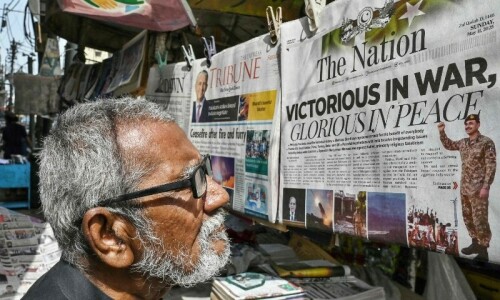
He said the ceasefire was not a weakness of Pakistan but a “strategic success”. “India was not in a position to bear further tension.”
Mr Tarar welcomed President Trump’s desire to resolve the Kashmir dispute, calling it a “good sign”. He said India accused Pakistan of being invovled in the Pahalgam attack without evidence. However, India “failed miserably” in linking the attack to Pakistan.
The attack, which took place in the presence of “around 700,000 Indian troops” in occupied Kashmir, was a “security and intelligence failure”, he added.
Mr Tarar reiterated Pakistan’s sacrifices in the war against terrorism, saying operations against terrorists were still ongoing on the western borders.
The minister denied any “safe havens” for terrorist groups inside Pakistan.
Published in Dawn, May 14th, 2025