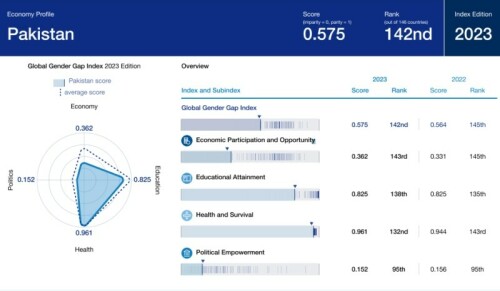
ISLAMABAD: Pakistan has one of the largest gender pay gaps (GPG) globally, with women earning significantly less than men across most sectors, according to a report by the International Labour Organisation (ILO).
The report, released on Monday, says that the majority of the pay gap in Pakistan is not due to differences in skills, education or labour market characteristics but is instead largely unexplained, suggesting the presence of gender-based discrimination.
The report highlights that Pakistan’s GPG remains higher than that of many other South Asian countries.
In Sri Lanka, the GPG based on hourly wages stands at 22pc. In Nepal, it is 18pc. In Bangladesh, the pay gap is actually reversed (-5pc), meaning women, on average, earn slightly more than men.
In Pakistan, the GPG is estimated at 25pc when using hourly wages and 30pc when considering monthly wages, meaning women earn between Rs700 and Rs750 for every Rs1,000 earned by men.
While the gender pay gap in Pakistan remains high, the report notes that it has decreased over the years. In 2018, the GPG was 33pc, indicating gradual improvement.
The report also finds that the GPG varies significantly across different segments of the labour market.
In the formal sector, the GPG is close to zero, meaning wages are nearly equal when employment laws are enforced. In informal and household sectors, the pay gap exceeds 40pc, indicating severe wage disparities in jobs without regulatory oversight. In the public sector, the gap is also relatively low, suggesting that strict labour regulations help reduce wage inequality.
GPG is a measurable indicator of inequality between women and men. Most governments have legislated to guarantee equality of treatment between men and women in remuneration. The ILO Equal Remuneration Convention, 1951 (No. 100) is one of the most highly ratified conventions.
Published in Dawn, March 11th, 2025