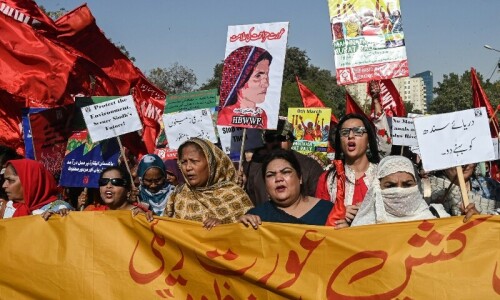
It’s that time of the year again when all of us pretend to care about how big the gender imbalance is in Pakistan. Some do it by sending cakes to their female employees; others put up a social media post talking about how addressing inequality is a must, while a few prefer to highlight their mothers, wives or daughters. The whole exercise is usually more about filling checkboxes at best and virtue signalling at worst.
None of this will obviously stop me from engaging in the same. Beyond the annual performance of concern lies the perverse reality of exclusion, particularly from the economic sphere. According to the International Labour Organisation’s estimates, Pakistan’s female labour force participation stands at just 24.5 per cent as of 2023 — meaning only one in four working-age women participates in the economy. Contrast this with men who have an activity rate of more than 83pc.
Among comparable economies, Pakistan’s female labour force participation exceeds only Egypt’s 16.5pc while lagging significantly behind Vietnam’s remarkable 68.5pc, Indonesia’s 53.3pc, Nigeria’s 52.2pc, the Philippines’ 47.2pc, and Bangladesh’s 37pc, and this is just scratching the surface; beneath these headline numbers lie perhaps a more concerning situation. For instance, around two-thirds of all working women in the country are employed in agriculture, and only 14.7pc are part of the formal sector.
By extension, this means that urban Pakistan seriously underperforms when it comes to women’s activity in the job market. At just 10pc, the urban female labour participation rate is well below the 28pc in the rural areas, with only Punjab managing to reach double digits.
This has a few implications: first of all, almost two-fifths of our population is now urban, which, by the way, has grown by 24pc between 2023 and 2017, far outpacing the 11pc increase seen in rural areas. As more families live in cities, affordability and living standards will become major challenges for single-income households. The mathematics is quite simple.
In a city like Karachi or Lahore, a family of five with a single income — typically the man’s — faces relentless financial pressure. Rent and electricity alone easily take up around half the monthly wages. And with time, support networks such as joint families will likely dwindle, each facing their own hardships.
Remember, this disparity in female labour force participation exists despite the fact that urban men and women exhibit quite similar higher education attainment levels — with 24.9pc and 22.7pc of their respective 19 and above populations having at least a two-year post-intermediate diploma. The gap narrows further when we limit our lens to only advanced degrees, ie a four-year Bachelor’s or higher.
As per the World Bank’s Women, Business and the Law index, Pakistan scores 58.8 out of 100, placing us fifth among seven peer countries, ahead of only Egypt and Bangladesh
Yet, the availability of qualified women has been far from enough to improve their chances of entry into the right job market. Take the services industry, which accounts for 38.2pc of all the employed population, remains heavily dominated by men. Except for education — where the female share stands at 39.6pc — it’s lower than 30pc in all subsectors of the economy.
In relatively high-paying industries, such as finance and information communication technologies, the situation is no better, as just 9pc and 4.9pc of their respective workforce comprises women. Needless to say, there is no singular reason behind this problem. Legal restrictions, safety concerns (both in and out of workplaces), and the lack of independence in making their own decisions are just some of the major factors that everyone and their uncle already know.
As per the World Bank’s Women, Business and the Law index, Pakistan scores 58.8 out of 100, placing us fifth among seven peer countries, ahead of only Egypt and Bangladesh. This index reveals a mixed picture: while the country scores perfectly on allowing women to work in the same jobs as men, the biggest deterrence was actually found to be parenthood support (20/100).
This exclusion carries a massive opportunity cost. Conservative estimates suggest that closing Pakistan’s gender gap in labour force participation could boost GDP by 20-30pc over the long term. In an economy plagued by low growth (anything over 4pc is usually termed as unsustainable by the professional analysts dominating media and policy spheres) and persistent poverty, it’s simply mind-boggling how little effort has been made to address this problem. I guess this is where we have let market forces do their job instead of making structural reforms that could unlock this massive economic potential.
But obviously, moving beyond International Women’s Day tokenism requires substantive action. Maybe those occupying positions of power could actually try something this time for a change instead of attending a networking event by some development sector organisation. As for me, I will just feel smug for the rest of the week for churning out a bunch of words.
Published in Dawn, The Business and Finance Weekly, March 10th, 2025