The federal government on Friday assigned portfolios to the cabinet inductees sworn in at the end of February while also reassigning the portfolios of serving federal ministers, according to notifications issued by the Cabinet Division.
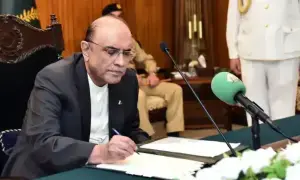
In an expansion on February 27, 12 federal ministers and nine ministers of state were sworn in by President Asif Ali Zardari. In addition, three advisers and four special assistants to the prime minister (SAPM) were also inducted.
The size of the federal cabinet doubled, increasing its members from 21 to 43, including 30 federal ministers, nine ministers of state and four advisers. Most of the newly inducted members belong to the ruling PML-N, but leaders from allied parties also secured positions in the cabinet.
According to today’s notification, available with Dawn.com, the appointments were made upon inductions as federal ministers and ministers of state, under clause (1) of Article 92 of the Constitution.
“The prime minister, under rule 3(4) of the Rules of Business, 1973, has been pleased to allocate the portfolios (business of the government) to the federal ministers and ministers of state,” the notification read.
The appointments are as follows:
New federal ministers:
- Dr Tariq Fazal Chaudhary — parliamentary affairs
- Ali Pervaiz Malik — petroleum
- Aurangzeb Khan Khichi — national heritage and culture
- Khalid Hussain Magsi — science and technology
- Muhammad Hanif Abbasi — railways
- Muhammad Mueen Wattoo — water resources
- Muhammad Junaid Anwar — maritime affairs
- Muhammad Raza Hayat Harraj — defence production
- Sardar Muhammad Yousaf — religious affairs & interfaith harmony
- Shaza Fatima Khawaja — information technology & telecommunication
- Rana Mubashar Iqbal — public affairs unit
- Syed Mustafa Kamal — national health services, regulations & coordination
New state ministers:
- Malik Rasheed Ahmad Khan — national food security & research
- Abdul Rehman Khan Kanju — power with additional portfolio of public affairs unit
- Aqeel Malik — law & justice
- Bilal Azhar Kayani — railways
- Kesoo Mal Kheal Das — religious affairs & interfaith harmony
- Mohammad Awn Saqlain — overseas Pakistanis & human resource development
- Mukhtar Ahmad Malik — national health services, regulations & coordination
- Talal Chaudhry — interior & narcotics control
- Wajiha Qamar — federal education & professional training
Meanwhile, according to a separate notification, former Khyber Pakhtunkhwa chief minister Pervez Khattak was appointed an adviser on interior affairs while Dr Syed Tauqir Hussain Shah and Muhammad Ali were appointed advisers to the PM’s Office and the privatisation ministry, respectively.
The four SAPMs were assigned their portfolios in a separate notification with Haroon Akhtar for industries and production, Huzaifa Rehman for national heritage and culture, Mubarak Zeb for tribal affairs and Talha Burki for political affairs.
The cabinet division also notified new portfolios for ministers already serving in the federal cabinet as follows:
- Khawaja Muhammad Asif — defence
- Azam Nazeer Tarar — law & justice with additional portfolio of human rights
- Musadik Masood Malik — climate change & environmental coordination
- Attaullah Tarar — information & broadcasting
- Dr Khalid Maqbool Siddiqui — federal education & professional training
- Qaiser Ahmed Sheikh — Board of Investment
- Abdul Aleem Khan — communications
- Chaudhry Salik Hussain — overseas Pakistanis & human resource development
- Rana Tanveer Hussain — national food security & research
According to Article 92 of the Constitution, no more than one-fourth of federal ministers and ministers of state can be from the Senate, and the total cabinet size cannot exceed 11 per cent of the total parliamentary membership.
Presently, the National Assembly and Senate have 336 and 96 members, respectively, totalling 432.
Having a hefty federal cabinet is not a new phenomenon in the country, as almost all previous regimes have claimed they would keep its size small, but later packed their cabinets.