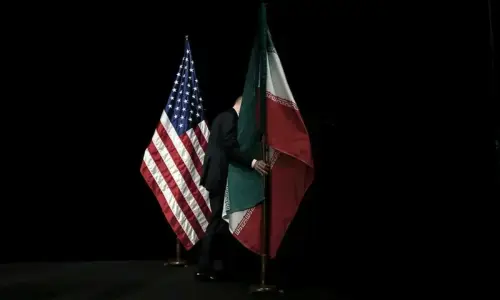
GENEVA: Iran and European powers met in Geneva on Monday under a shroud of secrecy to discuss Tehran’s nuclear programme, just a week before US President-elect Donald Trump takes office.
They were the second round of talks in less than two months, following a discreet meeting in Geneva last November between Tehran and the three European powers, Britain, France and Germany, known as the E3.
The meeting was largely shrouded in secrecy, with few details revealed about the topics discussed or even the venue of the talks. “The Iranian Deputy Foreign Minister Majid Takht-Ravanchi and his counterparts from the E3 met on Monday evening,” ISNA news agency reported.
“They discussed issues of mutual interest, including negotiations for lifting sanctions, the nuclear issue and the worrying situation in the region,” it added without elaborating. Later, Iran’s Deputy Foreign Minister for International Affairs Kazem Gharibabadi described the talks as “serious, frank, and constructive”. “We discussed ideas involving certain details in the sanctions-lifting and nuclear fields that are needed for a deal,” he said in a post on X.
“Sides concurred that negotiations should be resumed and to reach a deal, all parties should create and maintain the appropriate atmosphere. We agreed to continue our dialogue,” he added.
Before the meeting, the German foreign ministry said that the talks were “not negotiations” while Iran similarly emphasised that they were merely “consultations”. The talks, will cover a “wide range of topics,” Iran’s foreign ministry spokesman Esmaeil Baqaei said.
‘Breaking point’
On Thursday, France’s foreign ministry said the meeting was a sign that the E3 countries were “continuing to work towards a diplomatic solution to the Iranian nuclear programme, the progress of which is extremely problematic”. The talks come with Iran’s nuclear programme under renewed focus in light of Trump’s return to the White House on Jan 20.
During his first term, Trump pursued a policy of “maximum pressure”, withdrawing the US from a landmark nuclear deal which imposed curbs on Iran’s nuclear programme in return for sanctions relief.
Published in Dawn, January 14th, 2025