ISLAMABAD: The Supreme Court has constituted a three-judge committee to fix cases, issue court rosters, form benches and decide weekly caseload for its recently established constitutional bench.
According to the minutes of a Nov 6 meeting released on Monday, the committee comprises Justice Aminud Din Khan (head of the constitutional bench), Justice Jamal Khan Mandokhail and Justice Muhammad Ali Mazhar.
The meeting, held in Justice Amin’s chambers, was attended by Supreme Court Registrar Muhammad Salim Khan, Additional Registrar Judicial Nazar Abbass, Senior Research Officer Mazhar Ali Khan, Institution Officer Nazeer Ahmed, and judicial assistants Abdul Rehman and Mubashir Ahmad. The meeting was called to work out modalities for the rapid functioning of constitutional benches.
On Nov 5, the Judicial Commission of Pakistan (JCP) in its maiden session had picked Justice Amin as head of the constitutional bench by a seven-to-five majority.
Justice Shah questions role of regular benches until constitutional bench is formed
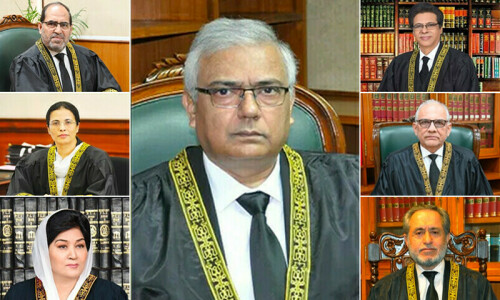
Chaired by Chief Justice of Pakistan (CJP) Justice Yahya Afridi, the reconstituted JCP formed a seven-member constitutional bench, including Justices Aminud Din Khan, Jamal Khan Mandokhail, Muhammad Ali Mazhar, Ayesha A. Malik, Hassan Azhar Rizvi, Musarrat Hilali and Naeem Akhtar Afghan.
As per the minutes, for cases relating to appeals involving Clause 4 of Article 191A of the Constitution, a committee comprising the most senior judge of the constitutional benches and the next two most senior judges from among the judges nominated under Clause 1 will constitute the bench consisting of not fewer than five judges.
The minutes also noted that a follow-up meeting will be scheduled once Justice Mandokhail returns from abroad.
During the meeting, Justice Aminud Din Khan was briefed on pending cases under Articles 184(1), 184(3) and 186, including human rights cases. A review of the current procedures for handling constitutional petitions and a proposed strategy for future operations were also presented.
The meeting decided on a colour-coding system for cases that fall under Article 191A, with Senior Research Officer Mazhar Ali Khan tasked to examine cases arising from Article 199.
SCBA praises bench formation
Meanwhile, newly elected Supreme Court Bar Association President Mian Muhammad Rauf Atta welcomed the formation of the seven-member constitutional bench, which he noted was necessitated by the 26th amendment.
He voiced optimism that the bench would soon commence work, reducing the significant backlog of constitutional cases and improving the Supreme Court’s overall efficiency.
He also welcomed recent initiatives taken by the CJP to enhance case management, including a monthly cause list, prompt scheduling of urgent hearings and addressing case backlog issues, calling these steps timely and essential.
‘Non-constitutional benches’
Justice Syed Mansoor Ali Shah, who was presiding over a three-judge bench on a tax matter on Monday, questioned the role of “non-constitutional benches” when no constitutional bench had been formed until then.
“Are we unconstitutional until the constitutional bench sits?” Justice Shah wondered when Justice Ayesha A. Malik observed during the hearing that the case at hand would be heard by the constitutional bench since the present bench was hearing regular cases.
“It means that constitutional cases will not be heard until the constitutional bench sits,” Justice Shah observed.
“Even if we hear this case, no one can question us,” Justice Shah said, recalling that this recurring question has surfaced again and again whether the case would be heard by a regular bench or a constitutional bench.
He also wondered what would happen even if a regular bench decided the matter.
“If we decide for ourselves, who is going to stop us?” Justice Shah observed, insisting that “if a review comes to us, we will say we have jurisdiction”.
However, the case was later adjourned for an indefinite period.
Published in Dawn, November 12th, 2024