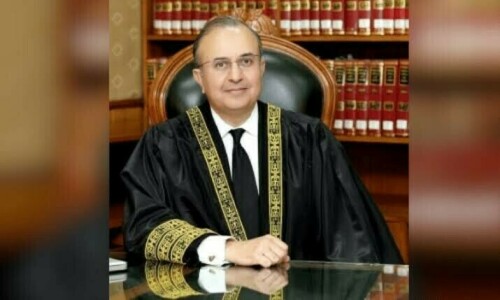
Justice Aminuddin Khan to head new constitutional bench in SC


• Selection made by seven votes to five, with CJP in a minority
• Seven-member panel has representation from all four provinces
• Three-judge committee to determine cases to be placed before the bench
• JCP ‘disregards’ letter from two judges seeking urgent meeting of Practice & Procedure committee
ISLAMABAD: In its maiden session on Tuesday, the Judicial Commission of Pakistan (JCP) — reconstituted under the 26th Amendment — appointed Justice Aminuddin Khan as head of the seven-judge constitutional bench by a majority vote of seven to five, with Chief Justice of Pakistan (CJP) Yahya Afridi among the dissenting members.
The seven-judge constitutional bench includes representatives from all four provinces: Justice Aminuddin Khan and Justice Ayesha A. Malik from Punjab, Justices Jamal Khan Mandokhail and Naeem Akhtar Afghan from Balochistan, Justices Muhammad Ali Mazhar and Hassan Azhar Rizvi from Sindh, and Justice Musarrat Hilali from Khyber Pakhtunkhwa.
Justice Aminuddin, who ranks fourth in seniority among Supreme Court judges, will lead the bench.
Those in the minority were CJP Yahya Afridi, senior puisne judge Justice Syed Mansoor Ali Shah, Justice Munib Akhtar, PTI leaders of the opposition in the Senate and the National Assembly Shibli Faraz and Omar Ayub.
The members in majority were Law Minister Azam Nazeer Tarar, Attorney General for Pakistan (AGP) Mansoor Usman Awan, Senator Farooq Hamid Naek, MNA Sheikh Aftab Ahmad, Roshan Khursheed Bharucha and Pakistan Bar Council (PBC) representative Akhtar Hussain.
The nomination for the constitutional bench is set for a period of 60 days as per legislation passed by parliament on Monday night that increased the number of Supreme Court judges from 17 to 34.
CJP Yahya Afridi, who presided over the JCP meeting, shared the judges’ views on the constitutional bench under Article 175(A) of the Constitution, suggesting a specific duration for the bench. Other participants also voiced their views, which were thoroughly debated. Ultimately, by a seven-to-five majority, the JCP approved a seven-member constitutional bench with representation from all four provinces, set for a two-month term.
With the Sindh Assembly having already passed a resolution to form a constitutional bench in the province by a simple majority under Article 202-A of the newly enacted 26th Amendment, another JCP meeting is expected in two weeks to nominate judges from the Sindh High Court for its constitutional bench.
During the meeting, Akhtar Hussain of PBC suggested that the judges appointed to the constitutional bench should be selected by seniority, excluding those who had benefited from the parliamentary panel or were considered for the CJP position.
However, the minority argued that the CJP should lead the constitutional bench and that it should include all Supreme Court judges, effectively forming a full court.
But this proposal was not accepted by the majority, who pointed out that it would create an anomaly since any appeal on the constitutional bench’s decision would go to a larger bench of judges who were not part of the original ruling.
Quorum issue
At the outset, Omar Ayub raised an objection regarding the JCP quorum, pointing out the absence of one member. This issue was put to a vote, and the majority affirmed that proceedings could continue in accordance with the Constitution despite one member’s absence.
According to an official announcement, CJP Afridi welcomed the participants and congratulated them on their nominations. The commission also discussed the establishment of a dedicated secretariat to support its functions. After thorough consideration, the JCP authorised the CJP to proceed with its rule-making and establishment.
The commission discussed the establishment of a dedicated secretariat to support its functions.
A three-judge committee, formed under the amended Supreme Court (Practice and Procedure) Act 2023 and comprising the CJP, Justice Mansoor Ali Shah and Justice Aminuddin Khan (being head of the constitutional bench), will decide which cases involving constitutional interpretation should be referred to the constitutional bench.
According to a source, the JCP did not consider a letter written by Justices Shah and Munib Akhtar.
In the October 31 letter, the CJP was urged to convene a meeting of the three-judge committee to quickly address the scheduling of constitutional petitions challenging the 26th Amendment.
The letter emphasised the urgency, and as a result, the two judges independently called an emergency committee meeting, resolving that the petitions be scheduled for hearing on Nov 4.
Published in Dawn, November 6th, 2024