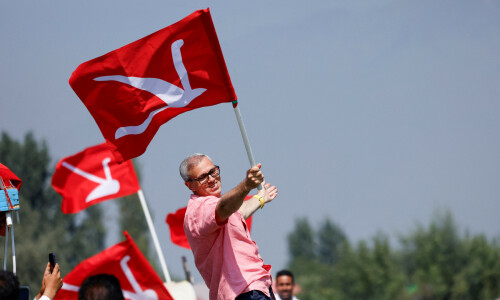
IF the Indian state is serious about its democratic credentials, then it should listen to the voices emanating from held Kashmir’s legislature calling for a restoration of the region’s special status.
On Wednesday, IHK’s assembly, which was elected last month after a decade, passed a non-binding resolution calling for the safeguarding of the disputed territory’s “identity, culture and rights”.
Though the resolution, piloted by the pro-India National Conference, which now rules IHK in a coalition with Congress, made no explicit reference to Article 370, the message to Delhi was clear. “The assembly has done its job,” said Omar Abdullah, IHK’s chief minister. Mr Abdullah had during the election campaign pledged to restore Article 370, discarded by India in August 2019, as well as the held region’s statehood.
Last month’s election results, as well as the recently passed resolution, clearly show that the people of held Kashmir are not happy with New Delhi’s snatching of their limited autonomy, and want India to reverse these dubious moves. The Indian prime minister has said statehood would be restored, though other members of his cabinet have said Article 370 is ‘done’ and ‘dead’.
While statehood, and the unity of held Kashmir — India has broken up IHK into two union territories of Jammu and Kashmir, and Ladakh — are important, the special status granted to the disputed territory under Articles 370 and 35A must also be restored. If most of India’s north-eastern states can continue to have a special constitutional status, to protect their culture and diversity, why is the BJP-led government being so rigid when it comes to occupied Kashmir?
Post-Aug 2019, there has been a conscious effort to change IHK’s demographic profile, and obliterate its unique identity. That is why nearly all political forces there — from pro-independence parties to those in New Delhi’s good books — are united in their demand for a restoration of the held territory’s special status.
Along with meeting a key demand of the Kashmiri people, reinstating the aforesaid articles would also help improve India’s ties with Pakistan. After the Modi government made its controversial move to strip IHK of its unique status, bilateral ties quickly nosedived. Therefore, if the BJP administration were to shed its rigidity on the matter and listen to the Kashmiris, it could pave the way for the resumption of the political process in IHK, along with removing a key obstacle in improving ties with Pakistan.
Hardliners in New Delhi may be telling themselves that the Kashmir question has been resolved, but the reality suggests otherwise. The IHK assembly resolution, in fact, offers New Delhi a face-saving option to restore Kashmir’s autonomy, as the administration can say it is only responding to popular demand. Should India choose to ignore this demand, disaffection in IHK will only increase.
Published in Dawn, November 8th, 2024