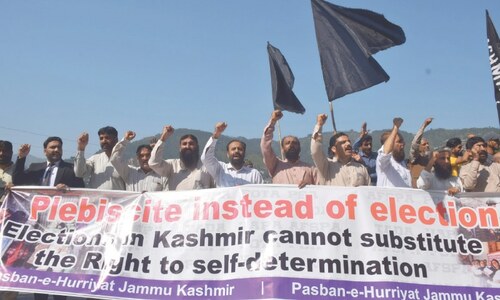
SRINAGAR: Three-stage assembly polls began in India-held Jammu and Kashmir on Wednesday, amid widespread reports of repression, as Amnesty International called on New Delhi to halt detentions of dissenters.
“Indian authorities must stop using restrictive travel bans and arbitrary detentions under the country’s stringent anti-terror laws to intimidate critical dissenting voices from speaking out on Jammu and Kashmir,” Amnesty said, ahead of the first elections in the disputed region in the last ten years.
These are also the first elections being held in the area following the revocation of its special constitutional status by the Modi government in 2019.
“The authorities’ escalating repression of human rights after India revoked the special autonomous status of the region has resulted in arbitrary detentions,” it said.
Amnesty referred to passports being revoked, the creation of opaque ‘no flying lists’, the denial of entry into India and arbitrary cancellations of Overseas Citizenship of India status of those with Indian and non-Indian citizenship speaking out against the repression.
“Anyone daring to speak out — whether to criticise the government or to stand up for human rights — faces a clampdown on their rights to freedom of expression and association and are unable to move freely within and outside the country,” said Aakar Patel, chair of the board at Amnesty India.
“The Indian authorities must end their campaign of harassment and intimidation against dissenting voices.”
Since the abrogation of Article 370 in 2019, which scrapped the region’s special semi-autonomous status, “we have verified the cases of at least five individuals… who have been prevented from travelling abroad or travelling into India, despite having the requisite travel documents,” the AI said.
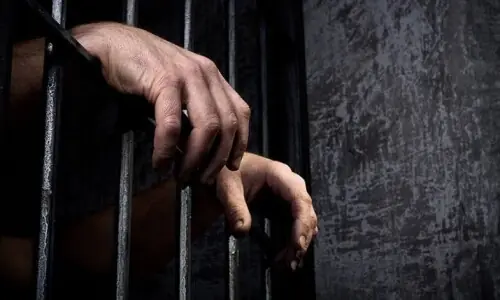
The government also continues to misuse the draconian Public Safety Act, which allows authorities to arbitrarily detain people without charge or trial, and the Unlawful Activities (Prevention) Act (UAPA) to carry out arbitrary detentions.
Passport confiscations
Amnesty documented two cases of critics facing passport revocation and one case of inordinate delays in issuance of passports.
Masrat Zahra, a Kashmiri photojournalist, has found herself in a state of limbo after her passport was revoked while she was pursuing education in the US.
“I cannot leave the United States, nor can I return to India. I’ve had to self-censor my thoughts, avoiding anything that might raise attention on social media,” Zahra said.
Waheed Para, a political leader associated with the opposition Jammu & Kashmir People’s Democratic Party (PDP), was accused by the National Investigation Agency of being a “threat to the security of the state”, and had his passport revoked in 2023 before he could travel to the US to start a fellowship.
Nitasha Kaul is a British-Indian professor of politics, who has testified about the human rights situation in India-held Kashmir before the US House Committee on Foreign Affairs. She holds a UK passport, but on Feb 23, she was denied entry to India.
In June, Indian authorities arrested the ex-president of the Jammu & Kashmir Court Bar Association, Mian Abdul Qayoom who had been critical about human rights violations and the abrogation of Article 370. In July 2024, they arrested three more lawyers.
Data published by the National Crime Record Bureau in 2022 shows that nearly 37 per cent of UAPA cases all over India were registered in India-held Jammu & Kashmir.
Khurram Parvez, coordinator of Jammu & Kashmir Coalition of Civil Society, and journalist Irfan Mehraj continue to be detained since 2021 and 2023, respectively.
In a further threat to human rights, the lieutenant governor of India-held Jammu and Kashmir was recently given absolute control over the jurisdiction of governance including the local administrative officials, prisons, prosecutions and law offices.
“The first step to ending the repression in Jammu and Kashmir is to immediately release all those detained under the Public Safety Act and Unlawful Activities (Prevention) Act for merely exercising their right to freedom of expression,” said Aakar Patel.
Published in Dawn, September 19th, 2024