0
0
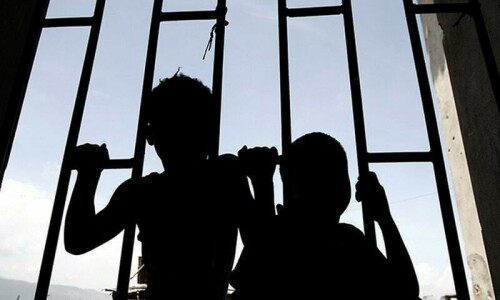
ISLAMABAD: Violence is a reality for half of the world’s children as one billion of them experience physical, emotional or sexual abuse every year.
“Experiencing violence is not only a violation of children’s rights, it also increases the risk of mental health conditions, non-communicable diseases such as diabetes and cancer, infectious diseases like HIV/AIDS, and social problems such as criminal activity and substance abuse,” said the World Health Organisation (WHO).
“Violence does more than harm individual children; it undermines the fabric of our society. It makes it harder for children to build happy, healthy lives and costs the global economy billions of dollars each year,” it stated.
To address this global tragedy, the governments of Colombia and Sweden, in partnership with WHO, Unicef and the UN special representative of the secretary general on ending violence against children will host the first-ever ministerial conference on ending violence against children in Bogota, Colombia on November 7and 8 this year.
It is hoped that the conference will also help secure a step-change in support for proven prevention solutions and reset collective ambitions to realise the 2030 Agenda for Sustainable Development target for every child to live free from violence.
“Possible outcomes will include revitalising country commitments for ending violence against children, announcing a new/renewed collective country-led initiative to end violence against children, launching a first-ever child/youth-led, movement dedicated to preventing child violence, adopting an inter-governmentally negotiated political declaration and hosting additional inclusive convening on pressing issues relating to ending violence against children,” it stated.
Meanwhile, the Ministry of Human Rights, in collaboration with WHO and Unicef, convened a consultation in Islamabad as part of the national preparatory sessions for the first global conference on ending violence against children (VAC).
The session assembled representatives from federal ministries, provincial governments, civil society, academia, and child protection experts to align Pakistan’s priorities with the global agenda to end all forms of violence against children.
Maryam Mallick, technical representative WHO, gave a detailed briefing on the global statistics on violence against children, objectives of the conference and the expected outcome.
Dr Luo Dapeng, WHO representative in Pakistan, Ayesha Raza Farooq, Chairperson National Commission of Child Rights, Sarah Ahmad, Chairperson CP and WB Punjab, Rabeea Hadi, Director CPI, Susan Andrew, Chief of Child Protection at Unicef, and Mohammad Arshad, Director General IC at the Ministry of Human Rights, attended the meeting.
Susan Andrew acknowledged Pakistan’s recent progress but emphasised that much more work remains to be done. She called for stronger political will and collaboration to ensure that child protection systems reach the most vulnerable.
Published in Dawn, October 6th, 2024