0
0

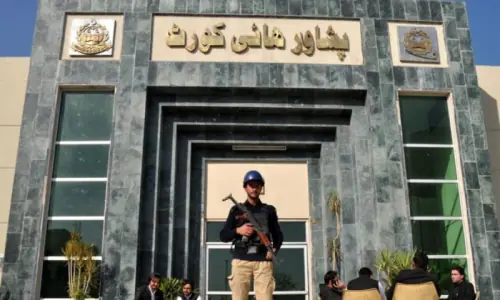
PESHAWAR: The Khyber Pakhtunkhwa Subordinate Judiciary Service Tribunal has set aside the Peshawar High Court’s 2017 orders for terminating the services of 11 judicial officers and ordered their restoration.
Justice Naeem Anwar, as a referee judge of the tribunal, accepted the appeals filed by a district and sessions judge, five additional district and sessions judges (ADSJs), four senior civil judges, and a civil judge.
Earlier, a tribunal comprising Justice Syed Mohammad Attique Shah and Justice Shakeel Ahmad heard those appeals but gave a split judgement, leading to their referral to the referee judge.
The appellants included district and sessions judge Sardar Mohammad Irshad, ADSJs Riffat Aamir, Qaiser Rahim, Abdul Hakeem Hashmi, Manzoor Qadir and Malik Amjad Rahim, senior civil judges Safeer Qaiser Malik, Adil Akbar Khan, Rashid Rauf Swati and Shah Hussain, and civil judge Tasawar Hussain.
They’re terminated by PHC in 2017 for ‘violating disciplinary law’
While terminating their services in April 2017, the high court announced that those judges had violated the disciplinary law.
At that time, Justice Yahya Afridi, now a senior Supreme Court judge, was the chief justice of the high court.
The high court had declared that after those judicial officers were found guilty, the chief justice with the concurrence of the administration committee had imposed the major penalty of removal from service on them.
Advocates Ziaur Rehman Tajik, Ahmad Sultan Tareen, Tariq Afridi, Fida Gul and others appeared for the appellants before the tribunal and contended that their clients were suspended in April 2017 under the Khyber Pakhtunkhwa Government Servants (Efficiency and Disciplinary) Rules, 2011, while show cause notices were served on them later over allegations about their general reputation, social contacts and conduct.
They added that on the basis of the show cause notices, the appellants had been proceeded against and awarded major penalty of removal from service.
The lawyers said the said show cause notices were mostly alleged to have been issued on basis of opinion drawn by the administrative committee against the appellants for having adverse entries recorded in some of their performance evaluation report, which they had already challenged.
They argued that adverse entries in respect of general reputation and conduct in the PER had been recorded by the committee without conducting any regular inquiry, which could confront the said allegations to the appellants.
The counsel argued that it was an established principle of law that no officer could be penalized without due process of law and affording an opportunity of fair defence.
They added that in the present cases, neither any charge sheet nor statement of allegations had been issued, which was a mandatory requirement of law.
The lawyers argued that the appellants were officers serving in grades 21, 20, 19 and 18 and they had been condemned unheard, which violated Articles 4 and 10-A of the Constitution.
They contended that there were no specific allegations against the appellants and merely on the basis of general allegations no major penalty could be imposed on them.
The counsel said the allegations concerning doubtful integrity must not be vague and unsupported by material.
They added that in view of lack of specific complaints of corruption, the adverse remarks regarding ‘doubtful integrity’ were unjustified hence were liable to be expunged.
Referring to superior court judgements, the lawyers argued that before any adverse remarks could be given, the reporting officer should issue a warning and offer counsel in writing.
They added that from the day of their appointments as the judges-cum-judicial magistrates, the appellants performed their duties with full devotion, dedication and honesty and enjoyed a good reputation amongst their colleagues.
Published in Dawn, July 27th, 2024