Pakistan, India exchange sharp words at UN Security Council over Afghanistan


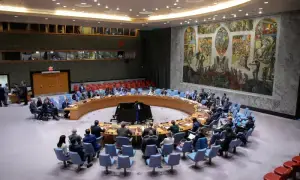
WASHINGTON: During a heated debate on Afghanistan at the United Nations Security Council (UNSC) on Monday, Pakistan lambasted India’s criticism of cross-border strikes, accusing Delhi of complicity in the terror threat at the western border.
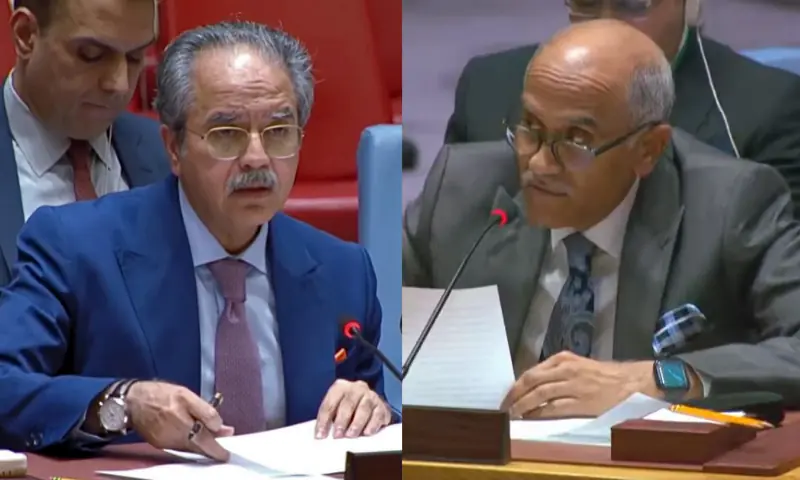
Pakistan’s Permanent Representative Ambassador Asim Iftikhar Ahmad exchanged strong words with his Indian and Afghan counterparts after the former accused Islamabad of “flagrant violations of international law” during the Pak-Afghan conflict.
During the session, India’s Permanent Representative Parvathaneni Harish said his country “reiterates UNSG’s deep concern at civilian casualties caused by cross-border violence and strongly condemns airstrikes which are flagrant violations of international law, UN Charter and state sovereignty”.
India also expressed “grave concern on ‘trade and transit terrorism’” and said “these vulnerabilities of Land-Locked Developing Countries should not be weaponised”.
India a ‘spoiler’ in Afghanistan: Pak envoy
Ambassador Ahmad, following the remarks from the Indian and Afghan representatives, said he was compelled to take the floor again, terming India’s remarks as “no surprise”, given India’s “animosity towards Pakistan and the sole objective of its Afghan policy being to destabilise Pakistan”.
He accused India of “actively supporting and sponsoring terrorist groups operating from Afghan soil, such as the Tehreek-i-Taliban Pakistan and Baloch Liberation Army”.
He noted that although India’s representative had spoken at length about the security situation in Afghanistan, mentioning civilian casualties and border clashes, there was no acknowledgement of the “terrorist threat emanating from Afghanistan” because of India’s own complicity in the situation.
He added that Pakistan had provided “irrefutable evidence of India’s collusion with terrorist groups that are engaged in orchestrating violent attacks against Pakistan”.
“One can sense India’s pain in seeing its heavy investment in the Afghan terrorist franchise going to waste as a result of Pakistan’s precise and effective action against terrorist camps and support bases inside Afghanistan,” Ambassador Ahmad remarked.
Responding to Indian concerns over Pakistani violations, the envoy described India as “a serial violator of international law” that had illegally occupied territory, violated the UN Charter and UNSC resolutions, perpetrated state terrorism in India-Occupied Kashmir and beyond, systematically marginalised minorities, spread hate, and weaponised water with the express goal of starving Pakistan’s population, and deployed disinformation as a state policy. “And the list goes on,” the envoy added.
Ambassador Ahmad stated that Pakistan’s “legitimate counter-terrorism operations are not directed against the brotherly people of Afghanistan, and are only meant to neutralise the persistent threat of terrorism emanating from Afghan soil”.
He added Pakistan’s actions were “in full conformity with the right to self-defence and international humanitarian law”.
In his concluding remarks, Ambassador Ahmad said that while India had “always played the role of a spoiler in Afghanistan,” Pakistan had “engaged responsibly in promoting peace, stability and prosperity in Afghanistan.”
He added that these goals could only be promoted if “the Taliban regime fulfils its commitments with respect to counter-terrorism, inclusive governance and upholding the rights of Afghan women and girls.”
He urged India to “cease and desist from its policy of stoking terrorism inside Pakistan from Afghan soil, now together with their newfound friends in the Taliban regime”, and said Pakistan would not allow “their sabotage and subversion from Afghan soil to nourish and harm Pakistan”.
Afghan envoy ‘cut off from ground realities’
The Pakistani envoy also took exception to remarks made by Naseer Ahmad Faiq, who serves as Chargé d’affaires ad interim of Afghan Permanent Mission to the UN ─ but is not officially recognised by Afghanistan’s de facto Taliban authorities. Faiq had highlighted civilian casualties in the Pak-Afghanistan conflict and stressed the need to fight terrorism. However, he did not mention Al Qaeda, the Tehreek-i-Taliban Pakistan (TTP), or other groups.
Ambassador Ahmad hit back at Faiq, questioning the value and credibility of his remarks. “The so-called representative of Afghanistan, who in fact does not represent anyone but himself, must not abuse this forum to pursue his personal agenda.”
Describing Faiq as “sequestered in New York”, Ahmad said the former was “completely cut off from ground realities” and had “chosen to selectively comment on some aspects of the situation, particularly with reference to Pakistan”.
Ahmad said Faiq had “nothing to say about cross-border terrorism from Afghanistan that is so heavily impacting Pakistan in terms of casualties among civilians, among our armed forces, law enforcement agencies and infrastructure”.