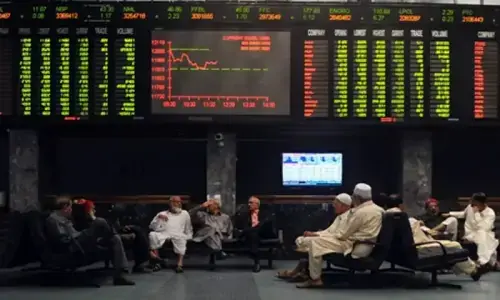
THE PDM coalition may have failed to set a direction for the flailing economy in its rather unimaginative second budget, but trade and industry leaders have been quite clear about how they believe Pakistan can chart a way out of its present crisis.
They have been pointing out some common-sense measures that successive governments have failed to implement, which include steps like fixing the country’s justice system, improving education delivery, reforming the bureaucracy, enforcing contracts, rightsizing the bloated machinery of the state, and forcing it to divest from businesses that have become a burden on the public exchequer.
The right interventions in these areas, most experts agree, can help create more wealth for both the citizenry and the government. Unfortunately, as the past year has shown, the country’s managers have seemed clueless about where to begin despite finding themselves in the midst of a major crisis.
The chairman of one of the largest conglomerates in the country, in a recent interview to Dawn, pointed to India as a case study. New Delhi implemented tough reforms following its last IMF programme some three decades ago, and is now reaping the rewards for its labours. He also echoed what many have been urging for a while now — that the revitalisation of trade with India, along with other regional economies, is a prerequisite to Pakistan’s long-term economic stability.
Unfortunately, Pakistan seems to have shut itself off to importing both good ideas or cheap goods from its eastern neighbour. Urging the government to reconsider, many have reasoned that when other countries with historical rivalries do not refuse to engage economically with each other, why should Pakistan and India? It is difficult to disagree.
Indeed, if one were to thoroughly account for the costs and benefits of Islamabad’s decision to suspend trade with India, the bottom line would reflect a net loss for our people. Perhaps it is time for our foreign policy pundits and decision-makers to reconsider their stance and decouple trade from geopolitical disputes.
From food to pharmaceuticals, Pakistan can import much from India and at far cheaper rates than from anywhere else in the world. Yet, we refuse to do so. With inflation crushing our citizens, the question ‘why’ must be revisited.
The state can keep pursuing its principled differences with New Delhi even while the two countries trade. It did so, for most of the two countries’ history.
Meanwhile, goods that can be bought for cheaper than the options available in the market should be allowed in so that the inflationary pressure can be relieved. Trade and geopolitics should be treated as independent components of international policy. Politicking on the matter is selfish and does no service to our people. Both our state and our politicians need to agree on this.
Published in Dawn, June 13th, 2023