Three Chinese astronauts arrive at space station


 1
1

BEIJING: Three Chinese astronauts arrived at the country’s space station on Sunday, the Chinese space agency for human flights said, the latest stride in Beijing’s aim to become a major space power.
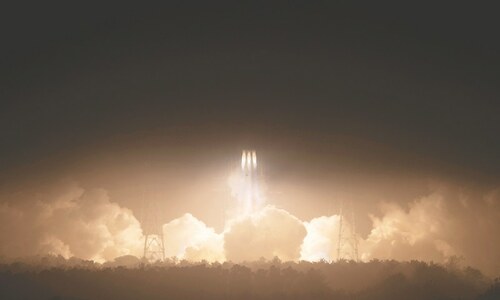
The trio blasted off in a Long March-2F rocket at 0244 GMT from the Jiuquan launch centre in northwestern China’s Gobi desert, reported state broadcaster CCTV.
The team is tasked with “completing in-orbit assembly and construction of the space station”, as well as “commissioning of equipment” and conducting scientific experiments, state-run CGTN said.
The astronauts entered the central module of the Tiangong station at around 1250 GMT, the China Manned Space Agency (CMSA) said. The journey took about “seven hours of flight”, CCTV reported.
Tiangong, which means “heavenly palace”, is expected to become fully operational by the end of the year.
China’s heavily promoted space programme has already seen the nation land a rover on Mars and send probes to the Moon.
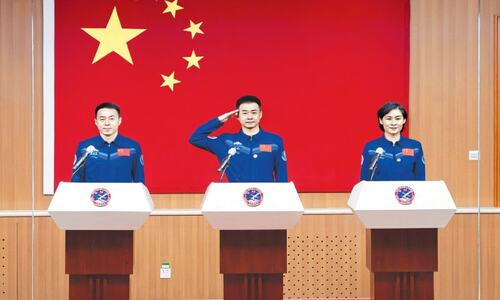
The Shenzhou-14 crew is led by air force pilot Chen Dong, 43, the three-person crew’s main challenge will be connecting the station’s two lab modules to the main body.
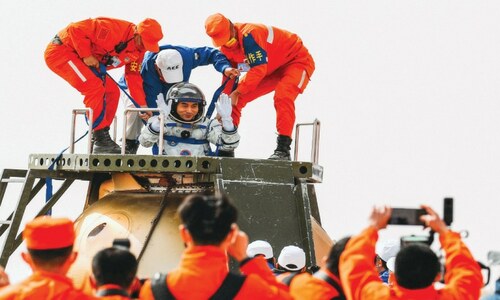
Dong, along with fellow pilots Liu Yang and Cai Xuzhe, will become the second crew to spend six months aboard the Tiangong after the last returned to earth in April following 183 days on the space station.
Tiangong’s core module entered orbit earlier last year and is expected to operate for at least a decade.
The completed station will be similar to the Soviet Mir station that orbited Earth from the 1980s until 2001.
The world’s second-largest economy has poured billions into its military-run space programme, with hopes of having a permanently crewed space station by 2022 and eventually sending humans to the Moon.
The country has made large strides in catching up with the United States and Russia, whose astronauts and cosmonauts have decades of experience in space exploration.
But under Chinese President Xi Jinping, the country’s plans for its heavily promoted “space dream” have been put into overdrive.
In addition to a space station, Beijing is also planning to build a base on the Moon, and the country’s National Space Administration said it aims to launch a crewed lunar mission by 2029.
China has been excluded from the International Space Station since 2011, when the United States banned Nasa from engaging with the country.
While China does not plan to use its space station for global cooperation on the scale of the ISS, Beijing has said it is open to foreign collaboration.
The ISS is due for retirement after 2024, although Nasa has said it could remain functional until 2030.
Published in Dawn, June 6th, 2022