Nasa extracts breathable oxygen from thin Martian air


 10
10

Nasa has logged another extraterrestrial first on its latest mission to Mars: converting carbon dioxide from the Martian atmosphere into pure, breathable oxygen, the US space agency said on Wednesday.
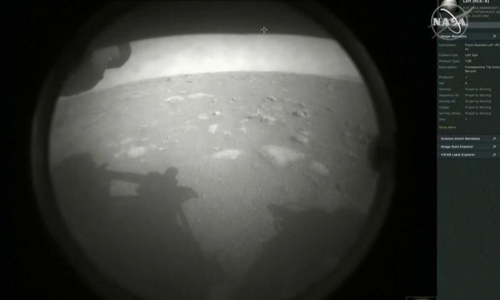
The unprecedented extraction of oxygen, literally out of thin air on Mars, was achieved on Tuesday by an experimental device aboard Perseverance, a six-wheeled science rover that landed on the Red Planet on Feb 18 after a seven-month journey from Earth.
In its first activation, the toaster-sized instrument dubbed "MOXIE", short for Mars Oxygen In-Situ Resource Utilisation Experiment, produced about five grams of oxygen, equivalent to roughly 10 minutes' worth of breathing for an astronaut, Nasa said.
Although the initial output was modest, the feat marked the first experimental extraction of a natural resources from the environment of another planet for direct use by humans.
“MOXIE isn't just the first instrument to produce oxygen on another world,” Trudy Kortes, director of technology demonstrations within Nasa's Space Technology Mission Directorate, said in a statement.
She called it the first technology of its kind to help future missions “live off the land” of another planet.
The instrument works through electrolysis, which uses extreme heat to separate oxygen atoms from molecules of carbon dioxide, which accounts for about 95 per cent of the atmosphere on Mars.
The remaining five per cent of Mars' atmosphere, which is only about one per cent as dense Earth's, consists primarily of molecular nitrogen and argon. Oxygen exists on Mars in negligible trace amounts.
But an abundant supply is considered critical to eventual human exploration of the Red Planet, both as a sustainable source of breathable air for astronauts and as a necessary ingredient for rocket fuel to fly them home.
The volumes required for launching rockets into space from Mars are particularly daunting.
According to Nasa, getting four astronauts off the Martian surface would take about 15,000 pounds (seven metric tons) of rocket fuel, combined with 55,000 pounds (25 metric tons) of oxygen.
Transporting a one-ton oxygen-conversion machine to Mars is more practical than trying to haul 25 tons of oxygen in tanks from Earth, MOXIE principal investigator Michael Hecht, of the Massachusetts Institute of Technology, said in Nasa's news release.
Astronauts living and working on Mars would require perhaps one metric ton of oxygen between them to last an entire year, Hecht said.
MOXIE is designed to generate up to 10 grams per hour as a proof of concept, and scientists plan to run the machine at least another nine times over the next two years under different conditions and speeds, Nasa said.
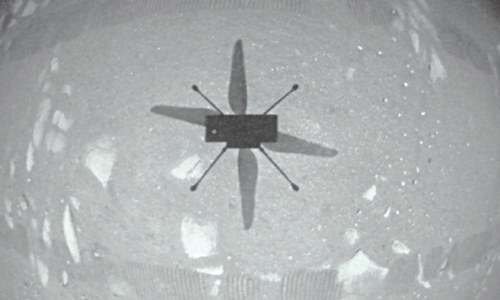
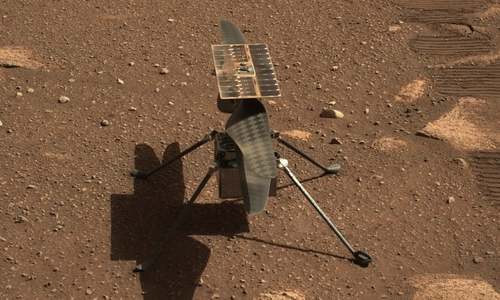
The first oxygen conversion run came a day after Nasa achieved the historic first controlled powered flight of an aircraft on another planet with a successful takeoff and landing of a miniature robot helicopter on Mars.
Like MOXIE, the twin-rotor chopper dubbed Ingenuity hitched a ride to Mars with Perseverance, whose primary mission is to search for fossilised traces of ancient microbes that may have flourished on Mars billions of years ago.