0
0

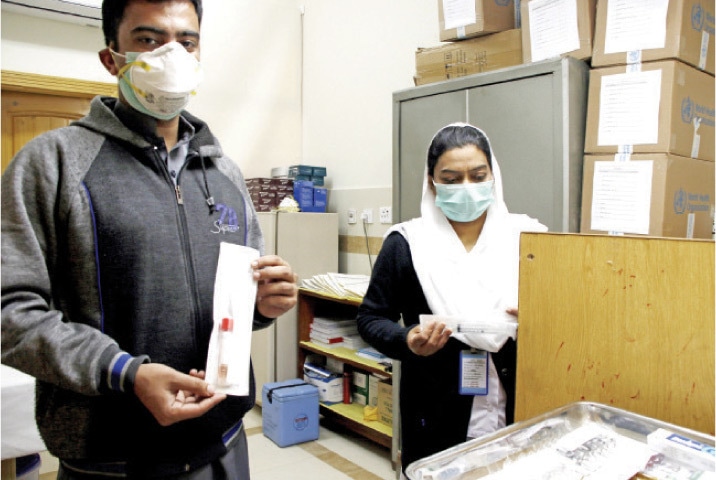
ISLAMABAD: The National Institute of Health (NIH) has declared negative all 17 samples of suspected novel coronavirus patients it received from various parts of the country.
There is no confirmed case in Pakistan at the moment, it said.
Meanwhile, Pakistan has banned export of N-95 respiratory masks which are exclusively used for protection against stagnant virus in the air.
The Drug Regulatory Authority of Pakistan (Drap) has been asked to provide a detailed report about the stock of masks and ensure its availability.
Besides, citizens have been advised not to panic as fear of the disease is more dangerous than the disease itself.
People having a good immune system will remain safe even if they are infected with the virus.
NIH Executive Director Maj Gen Prof Dr Aamer Ikram told Dawn that so far not a single coronavirus case had been confirmed in Pakistan.
“We have received 17 samples of suspected patients from different cities, including Rawalpindi, Lahore, Karachi and Multan, but none of them has tested positive. It shows that so far the virus has not been detected in the country. NIH has the capacity to diagnose the virus,” he said.
“Though we have arrangements at airports to screen every passenger, there is still a possibility that a passenger who got infected on the last day could pass the filter without detection, so we are vigilant,” he said.
Dr Ikram said only N-95 masks were used for protection from the virus so it had been decided to ban its export.
“Drap has been directed to check the stock of N-95 masks and ensure its availability,” he said.
Surgical masks are ineffective?
Microbiologist Prof Javed Usman told Dawn that influenza viruses spread from different routes such as water, edible items and air.
“We can avoid intake of viruses through water and edible items but it is difficult to avoid viruses that remain in the air. Many people use surgical masks to remain protected from viruses but they don’t know these masks are useless. The size of the virus is measured in a nanometre which is one billionth part of the metre. So it is the N-95 masks that are used to avoid the virus. However, they are not easily available in the market,” he said.
Surgical masks are available in the market for Rs10 but N-95 masks of different companies are sold for Rs200 to Rs400.
Does virus infect every person?
Prof Usman said: “If four passengers infected with the virus are sitting in different parts of an aeroplane the virus can reach every person in the plane. But we need to know that coronavirus is not like Ebola virus and does not infect every person.”
Ebola is a rare but deadly virus that causes fever, body aches and diarrhoea, and sometimes bleeding inside and outside the body. As the virus spreads through the body, it damages the immune system and organs. Ultimately, it causes the levels of blood-clotting cells to drop and leads to severe and uncontrollable bleeding.
“People having good immune system will not be infected even if the coronavirus reaches their bodies. That is why it is being observed that mostly people having weak immune system died of it. They were also suffering from some other diseases or health issues, which is called co-morbidity,” he said.
Screening people at airports
Prof Usman said though passengers were being screened at airports, he partially agreed with the practice.
“Passengers are being screened for fever. But we need to know that people having a good immune system will have fever as body starts resisting the virus, resulting in the fever. But people having a weak immune system may not have fever,” he said.
From where the virus originated?
According to Prof Usman, as per research strains of the virus show that it has 85pc particles of bat, so it might have come from it. There is no viral treatment and vaccine for the disease due to which treatment is done as per symptoms.
Published in Dawn, February 5th, 2020