28
28
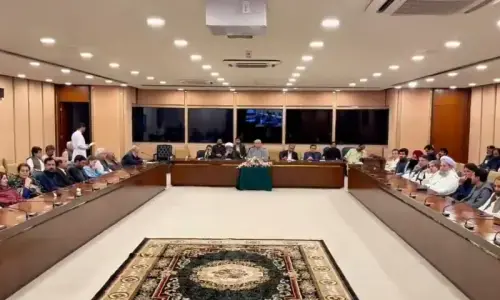
THE Special Committee of the Senate on the China Pakistan Economic Corridor has raised the demand for greater transparency in the execution of work under CPEC.
The government would be well advised to heed its words. The chair of the committee, Senator Sherry Rehman, said that her committee gets more information from the media than it does from the government, a state of affairs that is entirely unacceptable.
The ruling party, while it was in opposition under the previous government, used to regularly join in the chorus of demands for greater transparency on CPEC, and its representatives in parliament used to make the same demands at the time.
Now when they are in power they seem to have reverted to the same practice as their predecessor of keeping the country in the dark as large-scale work progresses under the CPEC banner.
Only last week, for example, Planning Minister Khusro Bakhtiar announced a series of decisions taken by the cabinet committee on CPEC from which it was quite evident that major changes will be made to Pakistan’s policy environment in order to take the corridor project forward.
He mentioned that a series of projects in agriculture, education, health, poverty alleviation, water supply and vocational training is about to be finalised and will be shared with Chinese counterparts soon.
Apparently, Chinese experts have been consulted extensively in drawing up this list. Sadly though, Pakistan’s own parliament remains unaware of what is being planned and how the projects will be paid for.
In addition, the minister also revealed that plans to shift the financing of the massive railway upgradation project known as ML1, which is the largest under the CPEC umbrella at $8.2bn, have gone back to where the previous government had left them.
The then PML-N government intended to finance the project through a Chinese grant which would be repaid with interest from the government of Pakistan’s resources. The PTI, upon coming to power, said it would like to renegotiate these terms to Build-Operate-Transfer instead, so that the repayment burden does not fall on the government and the Chinese can be asked to finance the project with their resources and recover their investment by operating the railway line themselves for a specified period of time.
It seems like the Chinese have refused this offer. Naturally, the government now has to consider the terms of repayment carefully, given the size of the project, and figure out how to manage them at a time when it is going to the IMF for balance-of-payments support.
Under an IMF programme, the government’s economic priority would be to build foreign-exchange reserves and narrow the fiscal deficit, which could become a challenge if massive projects are launched with borrowed money.
The Senate committee is right to emphasise its stake in the enterprise, and the government should move to allay its concerns.
Published in Dawn, March 17th, 2019